
Podcast background music needs to stay quiet enough to hear the host, and legal enough to survive distribution. Background music fails the second test far more often than the first.
Royalty-free does not mean free, and free does not mean safe for a podcast. Each source below names its license, its credit rule, and whether a monetized show may use it.
Seven sources passed, and every one of them costs nothing up front. Descript keeps background music 15 to 20 decibels under the voice (Descript, 2026).
A track that fights the host fails even when its license is clean.
Start from the pillar guide when a question goes beyond podcasts.
Podcast Background Music in Short
- Pixabay and Mixkit need no credit and allow commercial podcast use.
- Incompetech and Free Music Archive tracks need a credit when their license says so.
- Musopen fits classical scores, while ccMixter fits remixes built from shared stems.
- Podbean’s built-in library covers podcast use inside its own app.
- YouTube Audio Library tracks need a license check before they leave YouTube.
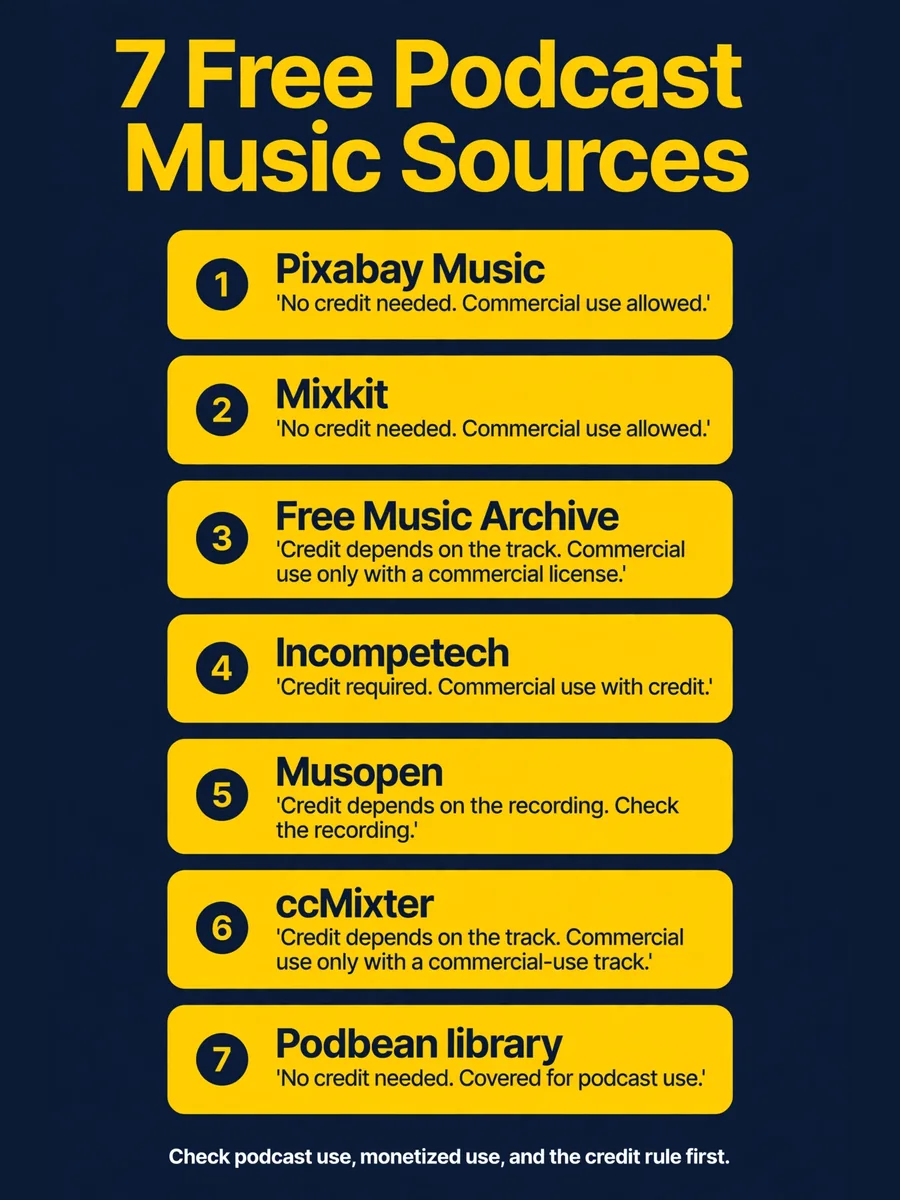
Seven numbered cards name the seven free sources, with each credit rule and monetized-use answer. The footer adds the three checks to run before downloading.
What makes a source safe for a podcast?
Podcast use must appear in the license itself, not just video use. Video-only permission leaves an audio feed uncovered, and that gap is where takedowns start.
With royalty-free, you pay nothing each time a track plays; with free, you pay nothing, period. Some royalty-free tracks cost money, so price and permission are two different questions.
Before downloading, check three things: podcast use, monetized use, and the credit rule. Save the track page and the license text, because a claim can arrive months after you publish.
The 7 sources
Every source below passed the same three checks: podcast use, monetized use, and a readable license. Terms were read on the source’s own pages in November 2026.
1. Pixabay Music
Pixabay’s audio library runs past 1.5 million tracks from independent artists, all free for personal and commercial use (Podbean, 2026). Its Content License asks for no credit, and podcast use counts as part of a larger creative work (Pixabay, 2026).
Watch the shield icon: tracks marked with it are registered with Content ID, so keep the track link and license summary as proof.
2. Mixkit
Mixkit is Envato’s free library, and its Stock Music Free License allows podcasts and online video (Mixkit, 2026). No account is needed, no credit is required, and tracks are browsed by genre, mood, or instrument (Buzzsprout, 2026).
Elsewhere on Mixkit, a few clips sit under a Restricted License for personal use only, so confirm the music license on the track page itself.
3. Free Music Archive
Free Music Archive collects independent music under Creative Commons licenses, and the license on each track is the rule you follow. CC BY tracks allow commercial use with a credit, while CC BY-NC bars commercial use and CC BY-ND bars adaptations (Free Music Archive, 2026).
Our Free Music Archive guide covers its filters in full. For a monetized show, filter for commercial use before you pick a track.
4. Incompetech
Composer Kevin MacLeod runs Incompetech, and its catalog holds hundreds of original tracks across many genres (Buzzsprout, 2026). Most tracks carry a Creative Commons Attribution 4.0 license, so commercial use is fine once you credit the composer (Incompetech, 2026).
Voice the credit inside the episode, since listeners never see show notes while they listen.
5. Musopen
Musopen is a nonprofit library of mostly instrumental music, with a focus on classical works in the public domain (Buzzsprout, 2026). Search runs by instrument, composer, or period, from Renaissance to the 21st century.
Five downloads per day come with a free account, and paid membership adds unlimited downloads (Buzzsprout, 2026). Check the rights on each recording, because Musopen does not guarantee every upload is public domain.
6. ccMixter
ccMixter is a global community where musicians share tracks for download, remixing, and sampling under the license on each track (Buzzsprout, 2026). Use commercial-use tracks for a monetized show, since non-commercial tracks carry narrower permissions.
Expect to dig: uploads are uncurated, so finding the right track takes longer than on a polished library.
7. Podbean music library
Podbean’s own app ships a built-in library of royalty-free music for intros and outros, covered for podcast use (Podbean, 2026). Record in the app, pick a track, and the app merges the music into the episode for you.
This is the only source here that lives inside a podcast host, so it suits creators who record on a phone.
The 7 sources at a glance
| Source | License | Credit | Monetized podcast |
|---|---|---|---|
| Pixabay Music | Pixabay Content License | Not required | Allowed |
| Mixkit | Stock Music Free License | Not required | Allowed |
| Free Music Archive | Varies by track, mostly CC | Depends on the track | Only with a commercial license |
| Incompetech | CC BY 4.0 | Credit required | Yes, with credit |
| Musopen | Varies by recording | Depends on the recording | Check the recording |
| ccMixter | Varies by track, mostly CC | Depends on the track | Only with a commercial-use track |
| Podbean library | Podbean in-app license | Not required | Covered for podcast use |
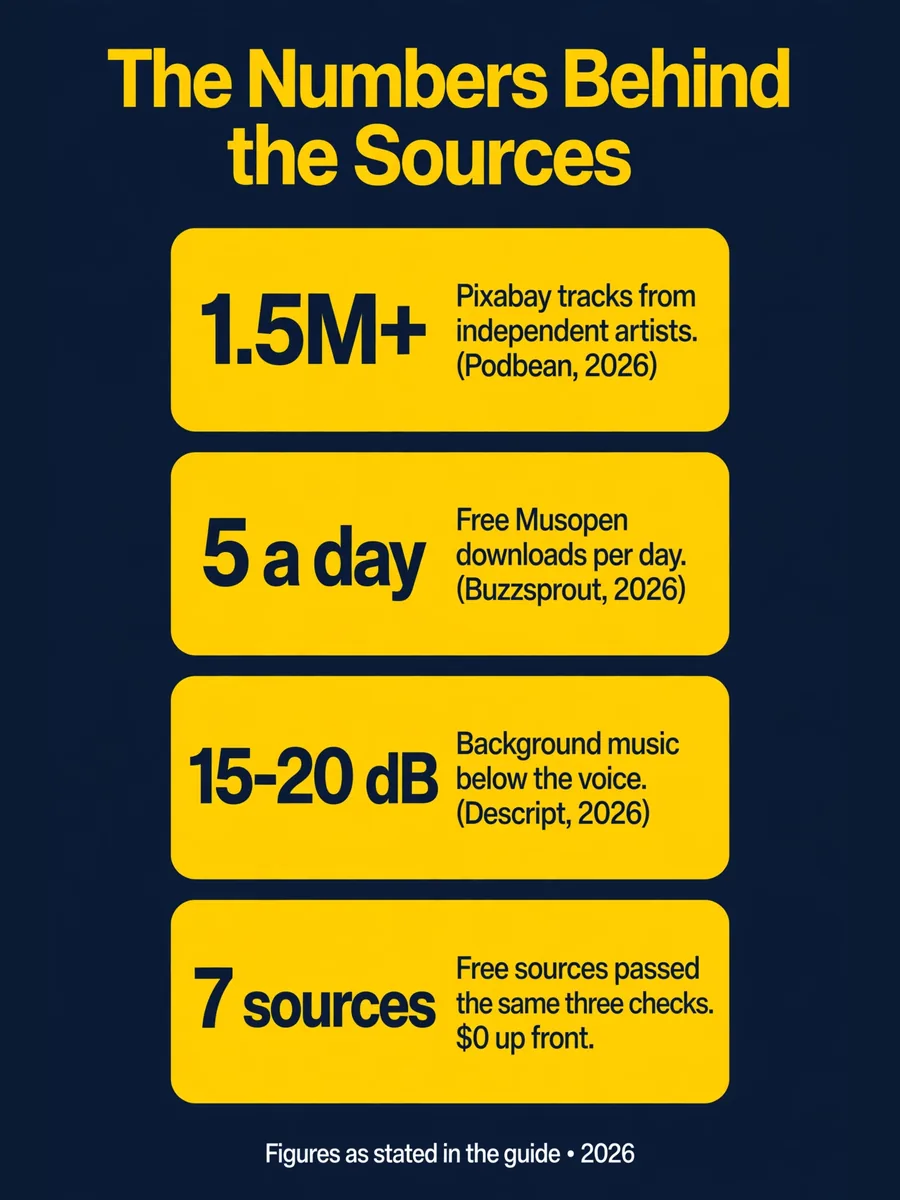
Four stat cards carry the figures behind the seven sources. They show 1.5 million Pixabay tracks, five free Musopen downloads a day, music 15 to 20 decibels under the voice, and seven free sources.
Three traps that still cause trouble
YouTube Audio Library tracks are free inside YouTube Studio, and many carry no attribution requirement. Outside YouTube, the platform’s assurances stop applying, so check the actual license on each track before it enters an audio feed (Buzzsprout, 2026).
Even a legal track can draw an automated claim when its composer registered it with Content ID. Those tracks carry a shield icon on Pixabay, and the dispute needs the track link, file name, and license summary.
Free to listen to is not free to publish, and a subscription that covers video may not cover audio. Match the license to the audio feed itself, not to the video version of the same episode.
My pick
Start with Pixabay and Mixkit for daily episodes, since neither asks for a credit line. Add Free Music Archive when the show needs character, and Incompetech when a scene needs a score.
Use Musopen for classical beds, ccMixter for remixes, and the Podbean library when you record on a phone. No source here hands you famous songs for free, because no legal library can.
Methodology
License pages were my source for every license claim below, read in November 2026. Roundup articles served only as pointers to those pages, never as the license itself.
License pages outrank this guide wherever the two disagree, so treat the source page as the final word.
Frequently asked questions
Can I use YouTube Audio Library music in my podcast?
Only after checking the track’s own license. YouTube’s assurances cover its own platform, not an audio feed elsewhere.
Which free tracks need an artist credit?
It depends on the license. Credit is optional on Pixabay and Mixkit, while Incompetech and CC BY tracks always need one.
A Content ID claim hit my licensed track — how do I get it cleared?
Answer with proof ready: track page, file name, license summary. Shield-marked tracks are the usual cause.
Will free music still let me earn from my podcast?
Yes, as long as the track’s license names commercial use as allowed. Filter for commercial licenses before you pick a track, not after.
Is royalty-free music the same as copyright-free music?
They differ: royalty-free only skips the per-play charge, while copyright-free means no owner claims rights at all.
References
- Free Music for Podcasts: 10 Sources & Licensing Tips – Buzzsprout
- Background Music for Podcast: How to Use It Well – Descript
- Where to Find Royalty-Free Music for Your Podcast – Podbean
- Pixabay Content License Summary – Pixabay
- Mixkit License – Mixkit
- License Guide – Free Music Archive
- Incompetech – Incompetech
2 Comments