
Can you use copyrighted music in a podcast? No, not without permission — playing a copyrighted song in your podcast without a license is infringement (Podcast Pontifications, 2026).
The rule holds even when you use only a few seconds, and even when you credit the artist.
Podcast feeds travel publicly across Spotify, Apple Podcasts, and YouTube, and public distribution is exactly the use that needs the rights holder’s permission. Five rules below keep a show on the safe side of that line.
The 5 Rules in Short
- Get permission for both copyrights: the composition and the recording.
- Short clips are not automatically fair use, and credit never replaces a license.
- Performance licenses from ASCAP or BMI do not clear a podcast.
- Buying a track or streaming it buys listening, not publishing.
- Keep written proof for every track, because platforms scan audio fingerprints.
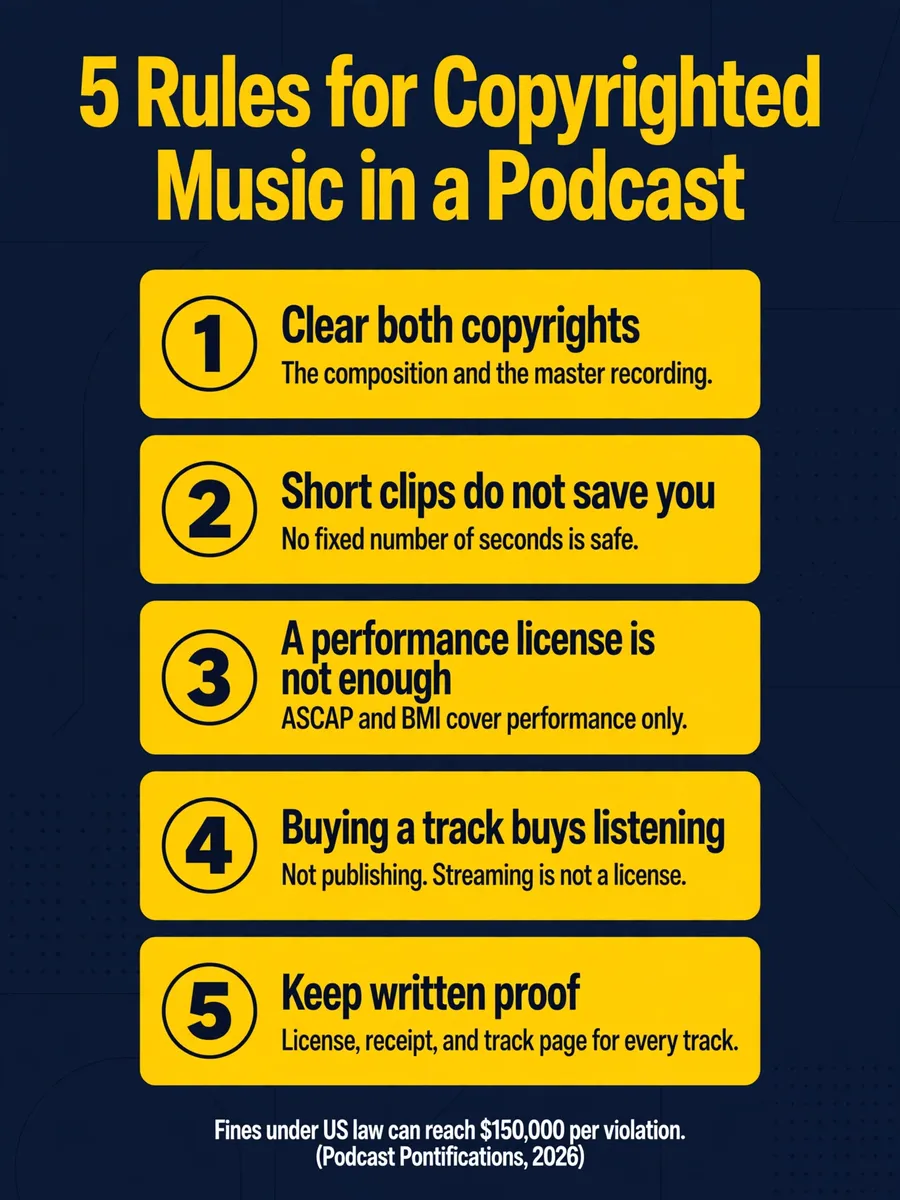
Numbered cards list the five rules for copyrighted music in a podcast, from clearing both copyrights to keeping written proof. Below the cards, a warning cites fines of up to $150,000 per violation under US law (Podcast Pontifications, 2026).
Rule 1: Clear both copyrights, not one
Every song splits into two copyrights: the composition, meaning words and melody, and the master, meaning that one recording. Each download hands the listener a copy, so permission must come from both sides (Beatpass, 2026).
Both permissions must name reproduction, distribution, and pairing the music with your content.
Songwriters and publishers usually control the composition, while a label or the artist who paid for the session controls the master. Permission from one side alone leaves the other side free to object.
Commissioned themes avoid the split entirely, since a composer you hire can grant both sides at once.
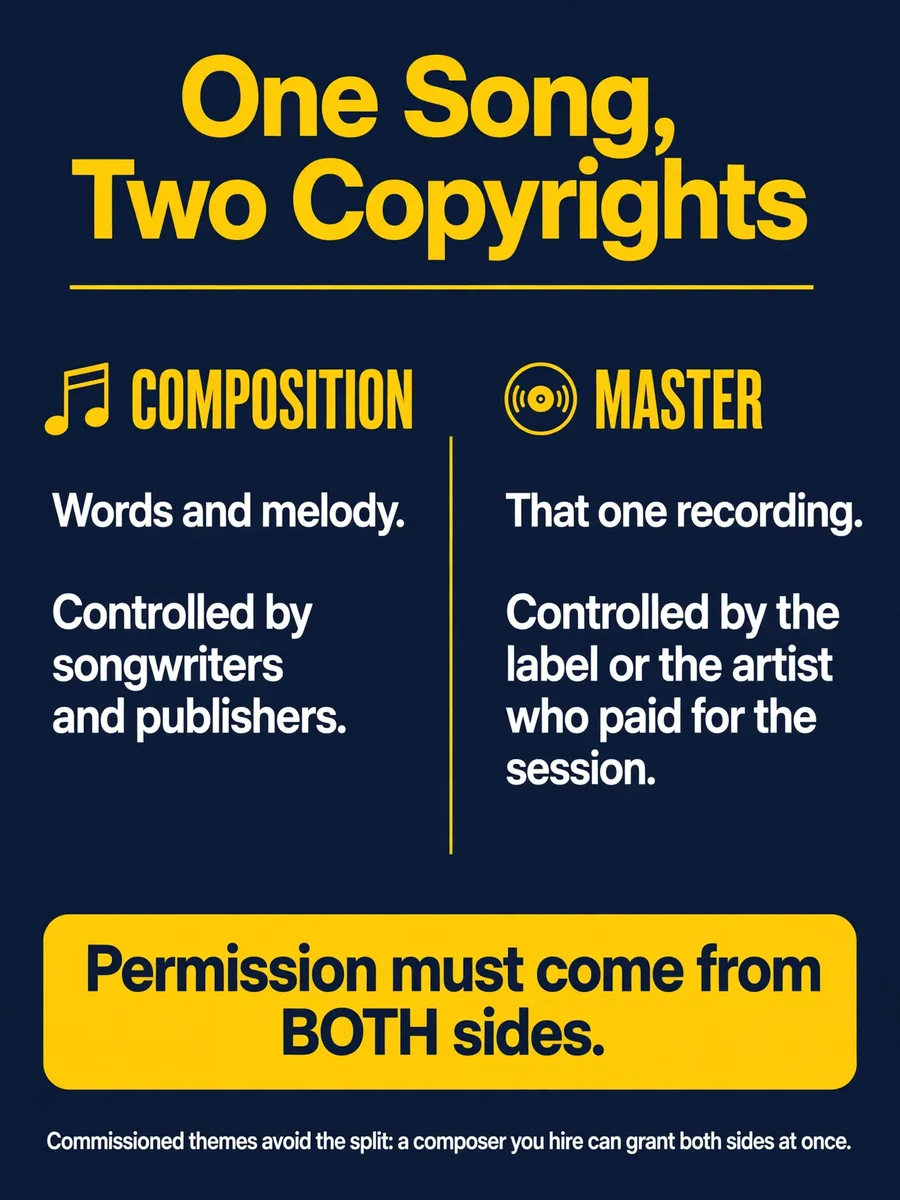
Two columns compare the composition copyright with the master recording copyright of one song. Permission must come from both sides, the banner states, and the footer adds that commissioned themes avoid the split.
Rule 2: Short clips and credits do not save you
A few seconds of a famous song is still infringement without a license. Pontifications states the point plainly: no, not without permission, even for a few seconds and even with credit (Podcast Pontifications, 2026).
Credit is a courtesy, not a license. Naming the maker is all it does, and it gives you no right to publish the track.
Fair use works as a legal defense, not a permission slip, with courts judging each case on its own facts (Podcast Pontifications, 2026). The four factors are the purpose of the use, the nature of the work, the amount used, and the effect on the work’s market value.
Fair use does not protect a theme or background track, since commentary, criticism, parody, and education are its usual ground, not general use as music.
Rule 3: A performance license does not clear a podcast
ASCAP, BMI, SESAC, or SOCAN sell a blanket license for public performance only.
It does not clear a podcast, because a download makes a copy (Beatpass, 2026). That copy needs permissions a venue performance never touches.
Podnews adds the other half of the warning: permission from the artist alone is not enough either.
You also need permission from the record company, the composers, and the publishers (Podnews, 2026). Add the mechanical and sync rights that allow copying the material.
Check what the license actually names before you pay for one. Neither a plan name, the word commercial, nor a downloadable file substitutes for the grant itself.
Rule 4: Buying a track buys listening, not publishing
Buying an MP3, owning the vinyl, or paying for Spotify gives you the right to listen (Podnews, 2026). It does not let you republish the recording inside your own show to an audience.
When you embed a song in an episode and distribute it, you become the publisher, and the publisher needs a license.
Streaming feels the same as publishing, since the same song comes out of the same speakers. Legally the acts differ: the platform already paid the rights holders for a private stream, while your episode creates new copies for every download.
Spotify scans every podcast episode for audio fingerprints and removes episodes that contain copyrighted tracks. Apple Podcasts does the same, and a small or non-commercial show gets no exemption (Podcast Pontifications, 2026).
Rule 5: Keep written proof for every track
February 2025 brought a warning shot: the National Music Publishers’ Association sent Spotify takedown notices for podcast uses of members’ songs without permission (Beatpass, 2026). Over 2,500 notices went out, with more promised.
Pulled episodes, demonetized shows, and blocked feeds are the usual consequences, and serious cases bring fines or legal action (Podcast Pontifications, 2026).
Fines under US law can reach $150,000 per violation, so the stakes are not theoretical (Podcast Pontifications, 2026). Store the license, the download receipt, and the track page with the show records.
Check that every track in the episode has a license behind it.
Five legal routes exist, per Podcast Pontifications: royalty-free tracks, directly licensed tracks, public domain works, Creative Commons tracks, and original music you create or commission. Royalty-free is the most popular of the five, because it is affordable, pre-cleared, and easy (Podcast Pontifications, 2026).
AI-generated music is no shortcut: Mubert’s free Ambassador tier bars commercial use and still asks for attribution (Buzzsprout, 2026).
What to use instead
Our 7 Free Podcast Background Music Sources That Are Safe lists seven free sources with their licenses checked for podcast use. For the wider rules beyond podcast licensing, read the pillar guide.
Start with a royalty-free library when you need a theme this week. Commission an original theme when the show needs a sound nobody else uses.
This article is general information, not legal advice.
Methodology
Rules were checked against Podcast Pontifications, Beatpass, and Podnews, plus the Buzzsprout roundup for AI-generated music terms, all read in November 2026. Both figures come from those pages, not from memory.
License terms change, so read the license issued for the track you actually use before you publish.
Frequently asked questions
Can I play 30 seconds of a song without a license?
Short clips are still infringement without permission, and no fixed number of seconds is safe.
Does crediting the artist make it legal?
Credit never replaces a license, and it does not stop a takedown or a fingerprint match.
Can I use a song if the artist said yes?
Artist permission alone cannot clear a track: the label, composers, and publishers must also agree, plus the mechanical and sync rights.
Is fair use enough for background music?
Case by case is how fair use is decided, and it does not protect a theme or background track.
Which music is legal for my podcast?
Pick royalty-free tracks, licensed tracks, public domain works, Creative Commons tracks, or music you create or commission yourself.
References
- Can I Play Music on a Podcast? A Complete Guide for Podcasters – Podcast Pontifications
- Using Music In Your Podcast: Fair Use Or Wise Choice? – Podcast Pontifications
- Music Licensing for Podcasts: Rights You Actually Need – Beatpass
- How to use commercial music in your podcast – Podnews
- Free Music for Podcasts: 10 Sources & Licensing Tips – Buzzsprout