

Main image: AI illustration.
Music streaming earned more than $22 billion in 2025, and that sum was 69.6% of all recorded music revenue worldwide (IFPI, 2026).
Subscriptions did the heavy lifting, with 837 million accounts paying for music by the end of 2025 (IFPI, 2026).
Listeners still played 5.1 trillion songs on demand during the year, a record total (Luminate, 2026).
This article puts every major number in one place, with the source and year beside each figure.
Summary
- Streaming took 69.6% of global recorded music revenue in 2025, and paid subscriptions alone took 52.4% (IFPI, 2026).
- Paid subscription accounts reached 837 million worldwide, up from a restated 764 million in 2024 (IFPI, 2026).
- On-demand audio streams hit a record 5.1 trillion in 2025, with 3.7 trillion outside the United States (Luminate, 2026).
- One stream pays a fraction of a cent on every major service, so volume decides artist income, not the rate (Ditto Music, 2026).
Streaming now earns seven in ten recorded-music dollars
Global recorded music revenue reached $31.7 billion in 2025, up 6.4% on 2024 (IFPI, 2026).
Momentum ran for an eleventh straight year, and the total passed $30 billion for the first time.
Growth also quickened: 2024 grew 4.8%, after 10.2% in 2023 and 9.0% in 2022 (IFPI, 2026).
Recorded music added $2.0 billion in a single year, the second-largest annual gain since 2019 (IFPI, 2026).
Only 2023 added more, at $2.6 billion (IFPI, 2026).
Digital listening supplied nearly all of that growth, passing $22 billion for the first time (IFPI, 2026).
Total streaming revenue grew 7.7% in 2025, after 7.3% in 2024 and 10.4% in 2023 (IFPI, 2026).
Subscription streaming grew faster than streaming as a whole, rising 8.8% in 2025 (IFPI, 2026).
Free tiers grew 4.3%, less than half the subscription rate (IFPI, 2026).
Ad-supported formats trailed subscriptions again in 2025 (IFPI, 2026).
| Year | Total revenue | Growth | Streaming revenue | Streaming share | Subscription growth | Paid accounts |
|---|---|---|---|---|---|---|
| 2023 | $28.6 billion | 10.2% | $19.3 billion | 67.3% | 11.2% | 667 million+ |
| 2024 | $29.6 billion | 4.8% | $20.4 billion | 69.0% | 9.5% | 764 million* |
| 2025 | $31.7 billion | 6.4% | $22 billion+ | 69.6% | 8.8% | 837 million |
Worldwide music revenue by year (Source: IFPI Global Music Report 2024, 2025, and 2026; 2024 paid accounts restated in the 2026 report, originally 752 million).
Recovery frames the scale: the industry bottomed at $13.1 billion in 2014 (IFPI, 2026).
Income has more than doubled since that low point, and streaming caused most of the rise.
| Format | Revenue | Share | Change |
|---|---|---|---|
| Paid subscription streaming | Near $16.6 billion | 52.4% | +8.8% |
| Ad-supported streaming | Near $5.5 billion | 17.2% | +4.3% |
| Total streaming | $22 billion+ | 69.6% | +7.7% |
| Physical | $5.3 billion | 16.6% | +8.0% |
| Performance rights | $2.9 billion | 9.3% | +0.3% |
| Synchronisation | $641 million | 2.0% | -2.0% |
| Downloads and other digital | About $790 million | 2.5% | -5.0% |
How global revenue splits by format, 2025 (Source: IFPI Global Music Report 2026; subscription, ad-supported, and download values are calculated from reported shares).
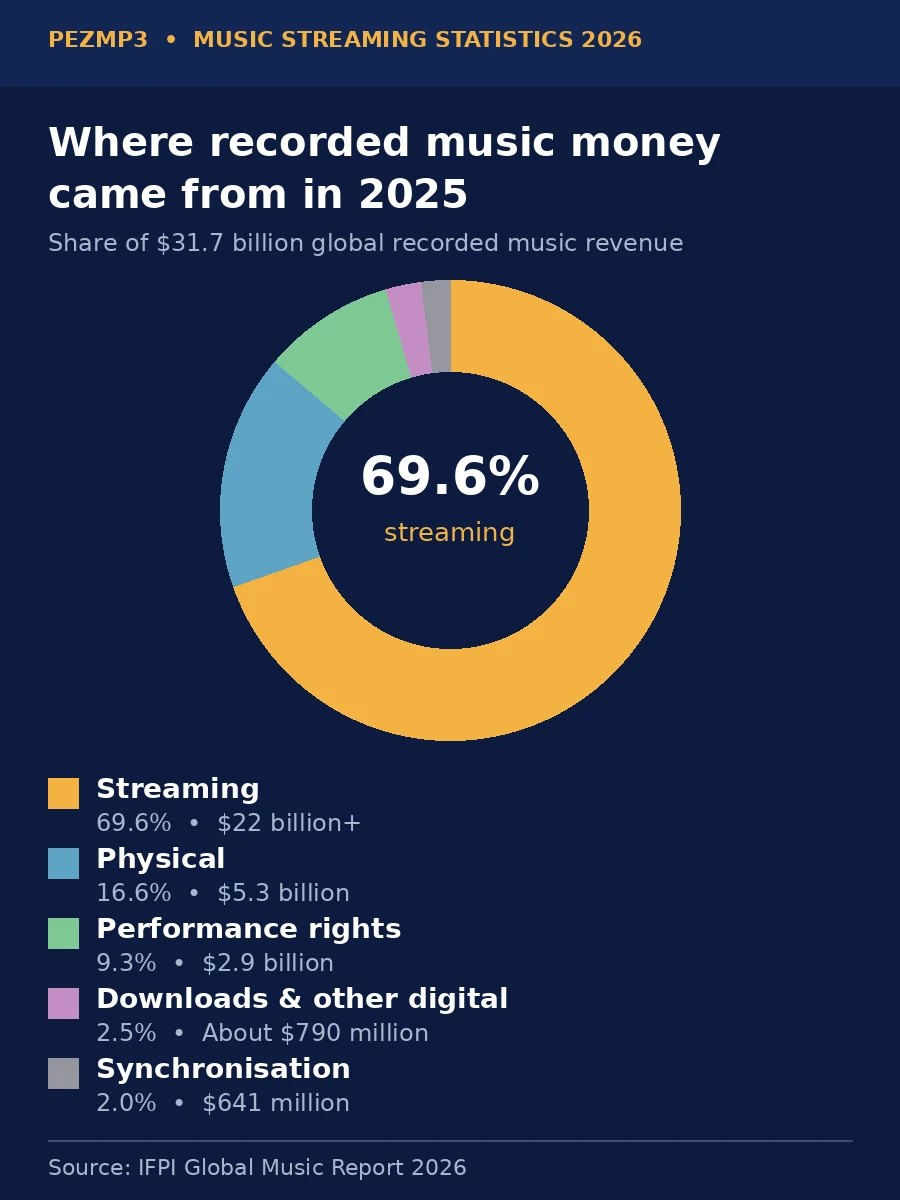
Global recorded music revenue by format, 2025: streaming 69.6%, physical 16.6%, performance rights 9.3%, downloads 2.5%, synchronisation 2.0%. Source: IFPI Global Music Report 2026.
Physical music revenue grew 8.0% in 2025 to $5.3 billion, after a 3.0% decline in 2024 (IFPI, 2026). Sales of vinyl grew 13.7%, its nineteenth straight year of growth, while CD revenue rose 3.7% and music video revenue rose 10.8% (IFPI, 2026).
Performance rights revenue reached $2.9 billion, up 0.3%, its fifth straight year of growth (IFPI, 2026). Synchronisation revenue fell 2.0% to $641 million, after four years of growth, while downloads and other digital revenue fell 5.0% (IFPI, 2026).
Paid subscriptions passed 837 million accounts
Subscription streaming passed half of all recorded music revenue for the first time in 2025 (IFPI, 2026).
That share reached 52.4% of the global total, up from 48.9% in 2023 (IFPI, 2026).
Revenue from subscriptions rose 8.8% in 2025, after 9.5% in 2024 and 11.2% in 2023 (IFPI, 2026).
Account growth slowed a little even as revenue kept climbing.
Accounts grew by 73 million in 2025, reaching 837 million worldwide (IFPI, 2026).
Price rises explain part of the pattern: more money arrived per account while fewer new accounts joined.
Spotify, the largest service, reported 300 million Premium subscribers in the second quarter of 2026 (Spotify, 2026).
Monthly users reached 777 million in the same quarter (Spotify, 2026).
Company estimates put the paying population above 750 million people a month across all services (Spotify, 2026).
People-based estimates sit below the 837 million accounts IFPI counted, because one person can hold more than one account.
MIDiA Research counted 921.6 million music subscribers worldwide at the end of 2025, up 10.1% on 2024 (MIDiA Research, 2026).
Its total runs higher than IFPI’s because the two firms define subscribers differently, so the figures describe the same market through different lenses.
| Service | Share of global music subscribers |
|---|---|
| Spotify | 31.4% |
| Tencent Music | 13.8% |
| Apple Music | 12.6% |
| YouTube Music | 12.4% |
| Amazon Music | 8.5% |
| All others | 21.3% |
Share of global music subscribers at the end of 2025 (Source: MIDiA Research, June 2026, via Music Business Worldwide).
Among major services, only Spotify reports subscriber counts every quarter.
Tencent Music reported 127.4 million paying users in the fourth quarter of 2025 (Tencent Music, 2026).
YouTube Music and YouTube Premium together reached 125 million subscribers in March 2025, including free trials (YouTube, 2025).
Deezer reported 8.9 million subscribers at 30 June 2026 (Deezer, 2026).
Apple Music and Amazon Music publish no subscriber figures at all.
Listeners played 5.1 trillion songs in 2025
Worldwide on-demand audio streams reached 5.1 trillion in 2025, up 9.6% on 2024 (Luminate, 2026).
Audio song streams count here, not video views.
Growth outside the United States ran more than twice as fast as inside it.
Outside the US, streams reached 3.7 trillion, up 11.6% (Luminate, 2026).
Inside the US, streams reached 1.4 trillion, up 4.6% (Luminate, 2026).
American share of global streams keeps shrinking as other markets grow faster.
| Year | Global streams | Outside the US | United States |
|---|---|---|---|
| 2023 | 4.2 trillion | — | 1.3 trillion |
| 2024 | 4.7 trillion* | 3.3 trillion | 1.3 trillion* |
| 2025 | 5.1 trillion | 3.7 trillion | 1.4 trillion |
On-demand audio song streams by year (Source: Luminate Year-End Music Report 2024 and 2025; 2024 restated to a 52-week basis, and totals are rounded).
Catalog growth explains part of the stream growth, and part of its pressure.
Catalogs held 253 million tracks at the end of 2025 (Luminate, 2026).
Distributors delivered about 106,000 new tracks to those services every day (Luminate, 2026).
Most of that catalog earns almost nothing: 88% of tracks drew 1,000 streams or fewer in 2025 (Luminate, 2026).
Nearly half of all tracks, 120.5 million, drew between zero and 10 streams all year (Luminate, 2026).
Listening concentrates at the other end instead.
Mid-tier tracks, with 1 million to 50 million global streams, supplied 49.4% of all streaming volume (Luminate, 2026).
Only 29 tracks passed 1 billion streams in 2025, two fewer than in 2024 (Luminate, 2026).
Lady Gaga and Bruno Mars owned the year’s most-streamed song, “Die With a Smile”, at 2.858 billion streams (Luminate, 2026).
Rap and R&B supplied 349.9 billion US on-demand audio streams in 2025, up from 341.63 billion in 2024 (Luminate, 2026). Christian and gospel music grew fastest among US genres, rising 18.5% (Luminate, 2026).
Growth moved outside the United States
Every region grew in 2025, and four regions grew by double digits (IFPI, 2026).
Latin America led at 17.1%, its sixteenth straight year of growth (IFPI, 2026).
Middle East and North Africa grew 15.2%, and Sub-Saharan Africa matched that rate (IFPI, 2026).
Asia grew 10.9%, helped by Japan returning to growth (IFPI, 2026).
Japan, the second-largest market, grew 8.9% after a flat 2024 (IFPI, 2026).
European Union revenue grew 5.1% to €6.0 billion, or 21.3% of the global total (IFPI, 2026).
Europe as a whole held 30.4% of global recorded music revenue (IFPI, 2026).
North American revenue grew only 3.5%, holding a 38.7% share (IFPI, 2026).
Regional revenue still added more than $400 million during the year (IFPI, 2026).
| Region | Revenue growth in 2025 |
|---|---|
| Latin America | +17.1% |
| Middle East and North Africa | +15.2% |
| Sub-Saharan Africa | +15.2% |
| Asia | +10.9% |
| European Union | +5.1% |
| USA and Canada | +3.5% |
Recorded music revenue growth by region, 2025 (Source: IFPI Global Music Report 2026 and IFPI Music in the EU 2026).
China grew fastest among the largest markets, rising 20.1% in 2025 (IFPI, 2026).
Chinese growth lifted the country past Germany into fourth place among world markets (IFPI, 2026).
Canada grew 5.6% and slipped one place to ninth (IFPI, 2026).
Brazil climbed to eighth and Mexico to tenth, so two Latin American markets now sit in the global top 10 (IFPI, 2026).
Every one of the ten largest markets grew in 2025 (IFPI, 2026).
| Rank | Market |
|---|---|
| 1 | United States |
| 2 | Japan |
| 3 | United Kingdom |
| 4 | China |
| 5 | Germany |
| 6 | France |
| 7 | South Korea |
| 8 | Brazil |
| 9 | Canada |
| 10 | Mexico |
Ten largest recorded music markets, 2025 (Source: IFPI Global Music Report 2026).
United States growth reached 3.3% by IFPI’s count, slightly above the RIAA’s 3.1% estimate (IFPI, 2026).
Two honest measurers can differ a little, and this article keeps both numbers visible.
The United States still pays the most per listener
Stateside recorded music revenue reached $11.535 billion at wholesale in 2025, up 3.1% (RIAA, 2026).
Nominal dollars set a record, though the total still trails the late-1990s peak after inflation (RIAA, 2026).
Streaming supplied $9.5 billion of the total, or 82% (RIAA, 2026).
Eighty-two percent has been the streaming share for five straight years.
Subscriptions drove the US result, as they did globally.
Paying accounts reached 106.5 million in 2025, up 6.5 million on 2024 (RIAA, 2026).
Premium subscription revenue rose 6.8% to $5.88 billion (RIAA, 2026).
All paid subscriptions together, premium plus limited plans, generated $6.4 billion, or 55.3% of US revenue (RIAA, 2026).
America holds about one-third of the global paid subscription market by value (RIAA, 2026).
| Category | Revenue in 2025 | Change |
|---|---|---|
| Total recorded music | $11.535 billion | +3.1% |
| Streaming | $9.5 billion | — |
| Premium subscriptions | $5.88 billion | +6.8% |
| All paid subscriptions | $6.4 billion | — |
| Ad-supported streaming | $1.79 billion | -0.6% |
| Non-premium subscriptions | $495.2 million | -4.5% |
| Other streaming | $1.31 billion | -3.8% |
| Vinyl | $1.04 billion | +9.3% |
| CD | $312.4 million | -7.8% |
| Downloads | $272.6 million | -0.8% |
| Synchronization | $407.1 million | -1.3% |
United States music revenue by category (Source: RIAA 2025 Year-End Recorded Music Revenue Report; all figures at wholesale, and 2024 restated on the same basis).
Ad-supported streaming slipped 0.6% to $1.79 billion, even as listeners kept growing (RIAA, 2026).
Non-premium subscriptions fell 4.5% to $495.2 million (RIAA, 2026).
Other streaming, including statutory radio royalties, fell 3.8% to $1.31 billion (RIAA, 2026).
Brightest physical story came from vinyl: 46.8 million units sold, worth $1.04 billion (RIAA, 2026).
Vinyl revenue rose 9.3%, its nineteenth straight year of growth (RIAA, 2026).
Vinyl sales in the US alone represent nearly half of the format’s global value (RIAA, 2026).
CDs moved the other way: 29.5 million units, down 11.6%, worth $312.4 million (RIAA, 2026).
Downloads fell only 0.8% to $272.6 million, helped by a 33.5% jump in other digital revenue (RIAA, 2026).
Subscriber growth in the US slowed for years, then bounced in 2025.
| Year | Net premium accounts added |
|---|---|
| 2020 | 15.1 million |
| 2021 | 8.5 million |
| 2022 | 7.6 million |
| 2023 | 5.2 million |
| 2024 | 3.2 million |
| 2025 | 6.5 million |
Net premium subscription accounts added per year in the United States (Source: RIAA 2025 Year-End Recorded Music Revenue Report).
Additions of 6.5 million accounts in 2025 were the most since 2022 (RIAA, 2026).
Price rises helped.
July 2024 brought a US Premium price rise from $10.99 to $11.99, and the higher price ran for a year in 2025 (RIAA, 2026).
Spotify paid the industry more than $11 billion
Spotify paid the music industry more than $11 billion in 2025, its largest annual payout (Spotify, 2026).
Lifetime payouts from Spotify now approach $70 billion (Spotify, 2026).
Payouts grew more than 10% in 2025, over twice the rate of other industry income (Spotify, 2026).
Roughly half of those royalties came from independent artists and labels (Spotify, 2026).
Payouts spread wider than the superstar tier, though the top still takes the most.
Over 13,800 artists earned at least $100,000 from Spotify alone in 2025 (Spotify, 2026).
Nearly 1,400 more artists joined that tier than the year before (Spotify, 2026).
Above $1 million sat more than 1,500 artists, and above $10 million sat more than 80 (Spotify, 2026).
Ten years ago, only the single top artist on Spotify reached $10 million in a year (Spotify, 2026).
| Earnings tier on Spotify | Artists in 2025 |
|---|---|
| $100,000 or more | 13,800+ |
| $1 million or more | 1,500+ |
| $10 million or more | 80+ |
| 100,000th highest earner | $7,300+ |
Counts of artists by annual Spotify royalty tier, 2025 (Source: Spotify Loud & Clear, 2026).
Rank 100,000 earned more than $7,300 from Spotify in 2025 (Spotify, 2026).
Back in 2015, that same rank earned about $350, a rise of more than twenty times since (Spotify, 2026).
Independent careers drive much of the widening.
DIY artists made up more than a third of those earning $10,000 or more, releasing through independent distributors (Spotify, 2026).
More than 90% of DIY royalties went to artists who had released music since before 2024 (Spotify, 2026).
Artists earning more than $500,000 came from 75 countries, up from 66 the year before (Spotify, 2026).
Earners of at least $10,000 came from more than 150 countries (Spotify, 2026).
Music travels in more languages than it did five years ago.
Songs in 16 languages reached Spotify’s Global Top 50 in 2025, more than double the count in 2020 (Spotify, 2026).
Among genres earning over $50 million in Spotify royalties, Brazilian funk grew fastest at 36% (Spotify, 2026).
K-Pop grew 31%, Latin trap 29%, Latin urban 27%, and reggaeton 24% (Spotify, 2026).
Songwriters shared in the year too: 2025 brought the largest annual music publishing payout in Spotify’s history (Spotify, 2026).
Publishers and songwriter organisations received about $5 billion over the past two years (Spotify, 2026).
Concerts added a second income line: Spotify drove more than $1.5 billion in gross ticket sales for artists (Spotify, 2026).
Artists using Spotify for concert offers grew by nearly 25% in 2025 (Spotify, 2026).
What one stream actually pays
Fixed prices per stream do not exist at any major service.
Services pool their subscription and advertising money, then divide the pool by each rights holder’s share of streams.
Averages from royalty statements show the result, and the range is wide.
| Service | Average per stream | Per 1 million streams |
|---|---|---|
| Qobuz | About $0.01873 | About $18,730 |
| Tidal | $0.012–$0.015 | $12,000–$15,000 |
| Apple Music | $0.007–$0.010 | $7,000–$10,000 |
| Deezer | $0.005–$0.007 | $5,000–$7,000 |
| Amazon Music | $0.004–$0.008 | $4,000–$8,000 |
| Spotify | $0.003–$0.005 | $3,000–$5,000 |
Average payout per stream by service. Attribution: Ditto Music and Royalty Exchange, via Groover, checked August 2026, with the Qobuz figure disclosed by Qobuz; all figures are averages, not fixed rates.
Spotify’s average sits at $0.003 to $0.005 per stream, or $3.00 to $5.00 per 1,000 streams (Ditto Music, 2026).
Duetti measured $3.00 per 1,000 streams for independent master owners in 2024 data (Duetti, 2025).
Listener location moves the average: Ditto Music gives $0.0039 for a United States stream against $0.0018 for a Portugal stream (Ditto Music, 2026).
Roughly two-thirds of the money its music generates goes to rights holders (Spotify, 2026).
Contracts then split that share between labels, distributors, publishers, and artists.
Recording royalties also flow only to tracks that reached at least 1,000 streams in the prior 12 months (Spotify, 2026).
Tracks below that line earn nothing from Spotify recording royalties, which matters because most tracks sit below it.
Qobuz pays the highest average, near $0.01873 per stream, but its audience is far smaller than Spotify’s (Qobuz, 2025).
Tidal pays the next-highest average, yet holds only about 2% of the subscriber market (MIDiA Research, 2026).
A high rate on a small service earns less in total than a low rate on the largest service.
The royalty-free corner: small, fast-growing, and hard to measure
Licensed background music is a small corner of the streaming economy, and its size is hard to pin down.
Research firms disagree because they define the market differently, so this article shows the range instead of picking one number.
| Firm | Market size in 2025 | Forecast |
|---|---|---|
| WiseGuy Reports | $2.64 billion | $5.0 billion by 2035 |
| PW Consulting | $2.15 billion | $6.63 billion by 2032 |
| Verified Market Reports | $1.5 billion | $3.2 billion by 2034 |
| Dataintelo (stock music) | $1.8 billion | $3.7 billion by 2034 |
Market estimates, royalty-free and stock (Source: WiseGuy Reports, PW Consulting, Verified Market Reports, and Dataintelo, 2025–2026; estimates differ because each firm defines the market differently).
WiseGuy Reports put the royalty-free music market at $2.64 billion in 2025, growing 6.6% a year to $5.0 billion by 2035 (WiseGuy Reports, 2025).
PW Consulting put its no-copyright music market at $2.15 billion in 2025, growing 17.45% a year to $6.63 billion by 2032 (PW Consulting, 2026).
Verified Market Reports put royalty-free music licensing at $1.5 billion in 2025, reaching $3.2 billion by 2034 (Verified Market Reports, 2026).
Licensing by subscription leads the segment: PW Consulting counted $1.44 billion from subscriptions in 2025, or 66.9% of its market (PW Consulting, 2026).
North America leads by region, at $855.91 million in 2025, or 39.8% of the PW Consulting market (PW Consulting, 2026).
Dataintelo counted the wider stock music market at $1.8 billion in 2025, with royalty-free tracks holding 68.4% of it (Dataintelo, 2026).
Short-form video drives demand: creators need legal background tracks for YouTube, TikTok, and Instagram Reels (PW Consulting, 2026).
Demand like that is exactly what this site serves, with free tracks under clear licenses.
Read our Royalty-Free Music guide for seven sources that cost nothing and carry written licenses.
Our Free Music Archive guide covers the largest Creative Commons library on the list.
Format choice matters too: read our Audio Formats guide before you download.
What 2026 has shown so far
Listening kept growing through the first half of 2026, with the same geographic split.
Global on-demand audio streams reached 2.8 trillion in the first half of 2026, up 9.8% (Luminate, 2026).
Streams outside the US reached 2.0 trillion, up 11.8% (Luminate, 2026).
US streams reached 732.7 billion, up 4.8% (Luminate, 2026).
Latin music streams worldwide reached 363.2 billion in the half, up from 335.3 billion a year earlier (Luminate, 2026).
US recorded music revenue reached $5,974.9 million in the first half of 2026, up 6.9% (RIAA, 2026).
Revenue from premium subscriptions grew 7.8% in the half, on 5.5% more premium units (RIAA, 2026).
Premium accounts averaged 111.1 million in the half, against 105.3 million a year earlier (RIAA, 2026).
| Measure | Figure |
|---|---|
| Global streams, first half 2026 | 2.8 trillion (+9.8%) |
| Streams outside the US, first half 2026 | 2.0 trillion (+11.8%) |
| US streams, first half 2026 | 732.7 billion (+4.8%) |
| US recorded revenue, first half 2026 | $5,974.9 million (+6.9%) |
| Premium subscribers, Q2 2026 (Spotify) | 300 million |
| Monthly users, Q2 2026 (Spotify) | 777 million |
| Premium subscribers, Q3 2026 (Spotify) | 306 million |
| Monthly users, Q3 2026 (Spotify) | 788 million |
How streaming performed in the first three quarters of 2026 (Source: Luminate 2026 Midyear Report, RIAA Mid-Year 2026 Report, and Spotify quarterly reports, 2026).
No service had reached 300 million Premium subscribers before the second quarter of 2026 (Spotify, 2026).
Its Premium average revenue per user rose 7% year on year to €4.89 in that quarter (Spotify, 2026).
By the third quarter, Premium subscribers reached 306 million and monthly users 788 million (Spotify, 2026).
Bank forecasts put recorded music at $43.4 billion by 2030 and $55 billion by 2035 (Goldman Sachs, 2025).
Superfan spending, premium tiers above the standard subscription, could reach $4.3 billion a year (Goldman Sachs, 2025).
Goldman Sachs also expects total music revenue, including publishing and live, to keep rising (Goldman Sachs, 2026).
Goldman Sachs puts the 2025 total at $112 billion and the 2035 total at almost $200 billion (Goldman Sachs, 2026).
Paid subscribers in the US, Canada, Europe, and Australasia should rise from 398 million in 2025 to 568 million in 2035 (Goldman Sachs, 2026).
Forecasts are not facts, and this article keeps them in a separate paragraph for that reason.
How to read these numbers without fooling yourself
Six traps catch readers of streaming statistics, and this article names each one.
First, wholesale is not retail: IFPI and RIAA figures count money paid to labels and distributors, not what listeners paid (IFPI, 2026).
A $31.7 billion wholesale total sits below the retail value of the same music.
Second, accounts are not people: IFPI counted 837 million accounts, MIDiA counted 921.6 million subscribers, and Spotify estimated 750 million-plus people paying (IFPI, 2026).
All three counts use different methods, so none of them is wrong and none is the only true count.
Third, years get restated: Luminate first reported 4.8 trillion streams for 2024, then restated the year to 4.7 trillion on a 52-week basis (Luminate, 2026).
IFPI first reported 752 million accounts for 2024, then restated the year to 764 million (IFPI, 2026).
Always check which vintage a figure comes from before comparing it with another year.
Fourth, averages are not prices: no service pays a fixed per-stream rate (Ditto Music, 2026).
Past royalty statements sit behind the $0.003 to $0.005 range for Spotify, not a price list (Ditto Music, 2026).
Fifth, estimates are not audited: royalty-free market sizes come from research firms, and their 2025 estimates span $1.5 billion to $2.64 billion (WiseGuy Reports, 2025).
Read the range, not a single figure, as the honest answer.
Sixth, growth does not lift everyone: streaming revenue and total streams rose together in 2025 (Luminate, 2026).
Yet 88% of tracks drew 1,000 streams or fewer that year (Luminate, 2026).
Rising totals and rising artist incomes are linked, not identical.
What this means if you make videos or music
The numbers point one way for creators: streaming pays the industry well and pays most individual tracks almost nothing.
That split decides the practical choice for anyone who needs music in a video.
Use free, legal music from a written license when the video earns its money from views, not from the soundtrack.
Royalty-free libraries and Creative Commons tracks cost nothing up front and carry no per-play bill later.
Our Royalty-Free Music guide lists seven such sources, with the attribution rule for each.
Release your own music on streaming when you want listeners to find it, not when you want quick income.
More than 13,800 artists earned $100,000 or more from Spotify in 2025, from a catalog of 253 million tracks (Spotify, 2026).
Those odds reward patience, catalog size, and touring, not a single upload.
This advice suits independent video creators, podcasters, and artists building a catalog over years.
Famous songs for free suit nobody here, because no legal library can give that.
Labels judging the industry find no fit here either (IFPI, 2026).
For them, the $31.7 billion total and the 837 million accounts are the numbers that matter (IFPI, 2026).
Methodology
Figures come from four primary releases: IFPI Global Music Report 2026 and the Luminate, RIAA, and Spotify reports for 2025.
Each was read in full or through its official summary on 23 November 2026.
Each figure here traces to one of them or to a named secondary source.
Mid-year 2026 figures come from Luminate 2026 Midyear Report, RIAA Mid-Year 2026 Report, and Spotify quarterly reports.
Per-stream averages come from Ditto Music and Royalty Exchange figures compiled by Groover in August 2026, plus a Qobuz disclosure.
Royalty-free market sizes come from four research firms, shown as a range because their definitions differ.
Calculated values are labelled “about”: subscription revenue near $16.6 billion, ad-supported revenue near $5.5 billion, and downloads near $790 million.
IFPI and RIAA figures are wholesale revenue, not retail value.
Restated years are flagged where they appear: Luminate 2024 streams and IFPI 2024 accounts.
Nothing here was estimated beyond the labelled calculations, and every source named was read directly or through the report that quotes it.
Frequently asked questions
How big is music streaming in 2026?
Streaming earned more than $22 billion in 2025, or 69.6% of global recorded music revenue (IFPI, 2026).
Paid subscriptions alone earned 52.4% of the total, with 837 million accounts worldwide (IFPI, 2026).
How many songs were streamed in 2025?
Listeners played 5.1 trillion on-demand audio songs in 2025, up 9.6% on 2024 (Luminate, 2026).
Streams outside the United States supplied 3.7 trillion of that total (Luminate, 2026).
How much does Spotify pay per stream?
No fixed rate per stream exists; the average ran $0.003 to $0.005 in 2026 figures (Ditto Music, 2026).
Tracks also need at least 1,000 streams in the prior 12 months to earn recording royalties at all (Spotify, 2026).
Which streaming service has the most subscribers?
Market leader Spotify holds 31.4% of global music subscribers at the end of 2025 (MIDiA Research, 2026).
It reached 300 million Premium subscribers in the second quarter of 2026 (Spotify, 2026).
Is royalty-free music a big market?
It is small beside streaming: estimates for 2025 span $1.5 billion to $2.64 billion, depending on the definition used (WiseGuy Reports, 2025).
The market grows steadily, and subscription licensing supplies most of its revenue (PW Consulting, 2026).
References
- Global Recorded Music Revenue Hits $31.7 Billion in 2025 as Streaming Passes $22 Billion
- Music Streams Hit a Record 5.1 Trillion in 2025, Luminate Reports
- US Recorded Music Revenue Reaches a Record $11.5 Billion in 2025
- Spotify Paid the Music Industry More Than $11 Billion in 2025
- What One Stream Pays in 2026: Fractions of a Cent on Every Major Service
- Music Streaming Services Stats (2026) — Exploding Topics