Main image: AI illustration.
What happens when free music costs you a video? Royalty-free music for YouTube sounds like a solved problem until a copyright claim takes the revenue.
Free to download is not the same as free to use, and that gap is where creators lose money.
Every source in this guide is free, legal, and checked against its own license page in November 2026. Each one states whether you must credit the artist, whether you can monetize, and whether Content ID can still flag you.
Pick by those three answers, not by catalog size.
Four facts carry the whole article.
- Start with the YouTube Audio Library or Mixkit when you want zero attribution and zero cost.
- Credit the artist on CC BY tracks, and treat Bensound and Uppbeat credits as one-video-only.
- Keep proof of every license, because a Content ID claim can arrive months after upload.
- Skip any site that cannot show you its license terms in writing.
Royalty-free means you owe no payment each time a video plays. It does not mean the track costs nothing, and it does not mean the track has no owner.
What does royalty-free actually mean?
Some royalty-free tracks are free, some cost money, and all of them come with conditions.
Copyright-free is a different claim, and a stronger one. A track with no owner claiming rights usually sits in that group, because the rights expired or the creator gave them up.
Most lists that promise “copyright-free music” actually mean royalty-free, so read the license instead of trusting the headline.
How to choose in 30 seconds
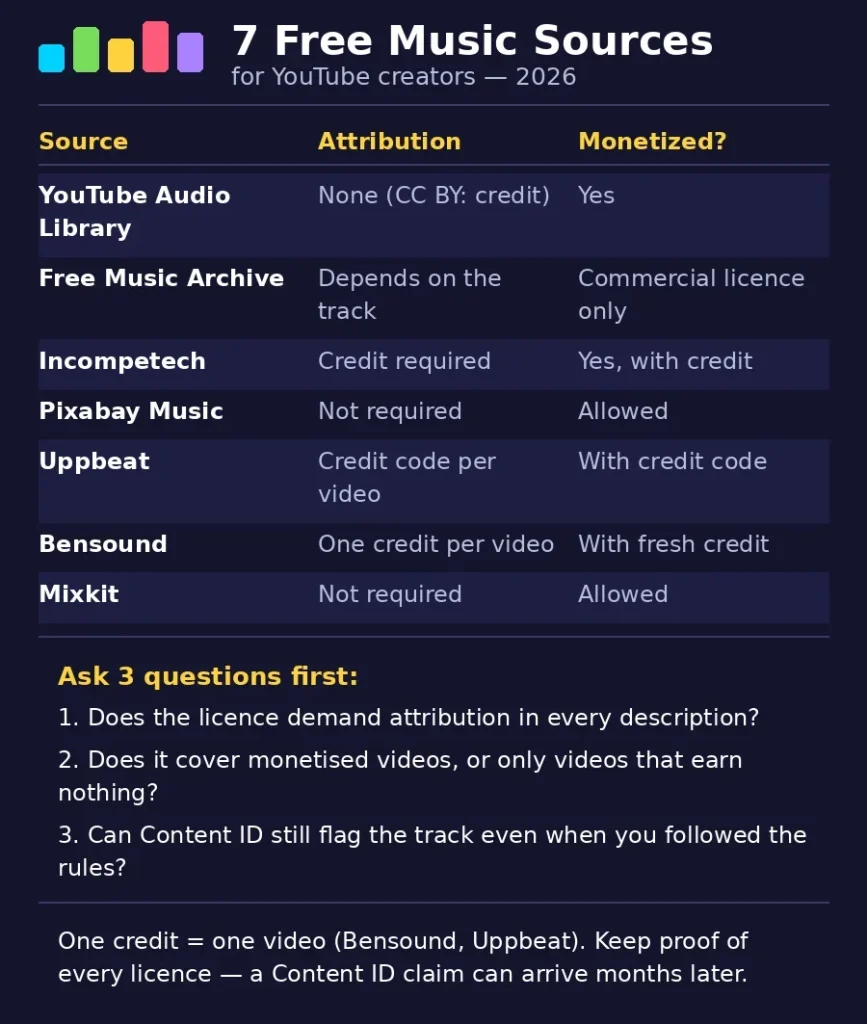
Ask three questions before you download anything. First, does the license demand attribution, and can you live with a credit line in every description?
Second, does it cover monetized videos, or only videos that earn nothing? Third, can Content ID still flag the track even when you followed the rules?
Your answers sort the seven sources below into two groups. Sources without attribution suit creators who publish daily and hate description chores.
Attribution sources suit creators who publish weekly and want a wider, stranger catalog.
The 7 sources
Seven sources made the cut, and each one passed the same check. License pages were read in November 2026, and the terms are quoted below.
1. YouTube Audio Library
Inside YouTube Studio sits the safest starting point on this list. YouTube built the Audio Library for its own creators, and its tracks are copyright-safe by design.
Most tracks carry the standard YouTube Audio Library License, which needs no attribution at all.
A smaller set carries a Creative Commons Attribution license, and those tracks do need a credit in your description. The license type shows in its own column, and YouTube writes the credit text for you.
Partner Program members can monetize videos that use these tracks, and YouTube states that Content ID will not claim them (YouTube, 2026).
2. Free Music Archive
Free Music Archive, known as FMA, is a library of independent music under Creative Commons licenses. Artists upload their own tracks and choose the license themselves, so the license on each track is the rule you follow.
Read the full walkthrough in our Free Music Archive guide.
Its search filters let you narrow by license and by use, including commercial use and use in a video. CC BY tracks allow commercial use with attribution, while CC0 tracks carry no conditions at all.
Watch out for the other flavors. CC BY-NC bars commercial use, and CC BY-ND bars adaptations such as using a track as a video soundtrack (Free Music Archive, 2026).
3. Incompetech
Composer Kevin MacLeod has run Incompetech since 1997, and its catalog holds about 1,400 original tracks (Incompetech, 2026). Search runs by genre, mood, tempo, and length, which makes it unusually precise for scoring a scene.
Downloads need no account, and the files arrive as MP3.
Nearly all tracks are free under Creative Commons Attribution 4.0, which allows commercial use as long as you credit the composer. Creators who cannot include a credit can buy a paid license instead.
Film and game scores dominate the catalog, so start here when your video needs mood rather than a beat.
4. Pixabay Music
Pixabay Music runs on the Pixabay Content License, which allows free commercial use with no attribution required. No account is needed to download, and the catalog spans thousands of community-uploaded tracks.
Vlogs, lifestyle videos, and podcasts fit it best.
Open upload is also its weak point, and this is the honest warning. Some composers register their tracks with YouTube Content ID after the fact, and Pixabay marks those tracks with a shield icon.
Check for that icon before you download, and keep the track page link and license summary as proof (Sonilo, 2026).
5. Uppbeat
Uppbeat curates human-made tracks for creators, and its free tier starts with 3 downloads, then adds 1 more each month (Soundstripe, 2026). Every download generates a unique credit code that must sit in one specific video description.
Reuse the same track in a second video, and you need a fresh download with a fresh code.
Its free tier clears tracks for monetized videos, and the credit code clears Content ID claims through the site’s own release tool. Solo creators on their own channels are covered, while client work and paid ads are not.
Treat Uppbeat as a small monthly ration of polished tracks, not as an unlimited library.
6. Bensound
Bensound is one musician’s catalog of background instrumentals, and its free license covers tracks in the Free Music section. Downloading a track generates an attribution text with a unique license code, and that text is valid for one video only.
Paste it exactly as provided, because a missing or mistyped credit can trigger a claim.
Monetized YouTube videos are covered under the free license, and paid plans remove the attribution requirement. Corporate, acoustic, and cinematic tracks are its strong suit.
Download a fresh attribution text for every new video, even when you reuse the same song (Bensound, 2026).
7. Mixkit
Mixkit is Envato’s free library of stock video, music, sound effects, and templates. Music tracks here carry the Mixkit Free License, which allows commercial use with no attribution required and no sign-up.
Curated quality is the draw here, since Envato’s team picks every track.
Check the license shown on each track page before you use it. Nearly all music sits under the Free License, while a few video clips elsewhere on Mixkit carry a Restricted License for personal use only.
Keep the track page open until your video is published, so you can prove which license applied (Mixkit, 2026).
The 7 sources at a glance
| Source | License | Attribution | Monetized videos |
|---|---|---|---|
| YouTube Audio Library | YouTube license or CC BY | None, except CC BY tracks | Yes |
| Free Music Archive | Varies by track, mostly CC | Depends on the track | Only with a commercial license |
| Incompetech | CC BY 4.0 | Credit required | Yes, with credit |
| Pixabay Music | Pixabay Content License | Not required | Allowed |
| Uppbeat | Free tier license | Specific credit phrase | With the credit phrase |
| Bensound | Free License with Attribution | One credit per video | With a fresh credit |
| Mixkit | Mixkit Free License | Not required | Allowed |
Three mistakes that still get claims
Reusing a credit is the first mistake, and Bensound and Uppbeat punish it. Each attribution text or code covers exactly one video, so a second video with the same credit has no valid license.
Download a fresh credit for every upload, even when the song stays the same.
Trusting “no attribution” as “no claims” is the second mistake. Pixabay tracks can carry Content ID registrations from their composers, and the claim arrives after you publish.
Save the track URL, the file name, and the license summary the day you download.
Using a non-commercial track in a monetized video is the third mistake. Tracks marked CC BY-NC on FMA are free to download, and they still bar commercial use.
Monetized videos count as commercial use, so filter for commercial licenses before you fall in love with a song.
My pick
Start with the YouTube Audio Library and Mixkit, and add Free Music Archive when you want character. That trio covers daily publishing with zero attribution chores, plus a deep bench of independent music for videos that deserve something stranger.
Incompetech joins the rotation when a scene needs a score rather than a song.
Uppbeat and Bensound fit creators who publish weekly and can manage one credit per video. The Pixabay option fits creators who check the shield icon every time and keep proof.
No source here fits a creator who wants famous songs for free, because that creator wants something no legal library can give.
Paid libraries and podcast music belong to the pillar guide Free Legal Music for Creators, once it is published.
Methodology
License terms were read on each source’s own license or FAQ page in November 2026, and every claim about a license traces to that source. Limits and attribution rules came from the same pages, not from roundups.
AI assisted the first draft; all facts were manually verified against the sources listed in References.
This site covers legal music only, as stated on our about page. Nothing here is legal advice for your situation; when a license page and this guide disagree, the license page wins.
Frequently asked questions
Is royalty-free music really free?
Not always.
It means no payment per play, while free means no payment at all. Tracks in this guide cost nothing up front, because only sources with a free tier made the list.
Can I monetize a video that uses free music?
Yes, when the license allows commercial use.
YouTube Audio Library, Mixkit, and Pixabay allow it without attribution, while Incompetech, Bensound, and Uppbeat allow it with credit. Read the license on each track first.
What happens if I get a Content ID claim on a legal track?
Dispute it in YouTube Studio with your proof: the track page link, the license summary, and your attribution text. Audio Library tracks should not draw claims at all, while Pixabay and Bensound claims usually clear once you show the license.
Do I need to credit the artist on every track?
Not on every track.
Standard-license Audio Library tracks, Mixkit, and Pixabay need no credit. FMA and Incompetech tracks under CC BY always need one, and Bensound and Uppbeat need a specific credit per video.
Can I use these tracks in a podcast or on TikTok?
Mostly yes, with conditions.
Mixkit and Pixabay allow podcasts under their licenses, while Uppbeat’s free tier covers solo creators on social platforms. Bensound’s free license covers online videos that viewers can watch free of charge.
References
- Use music and sound effects from the Audio Library – YouTube Help
- License Guide – Free Music Archive
- FAQ For Videos & Films – Free Music Archive
- Incompetech
- Pixabay Music and Sound Effects Alternatives in 2026 – Sonilo
- Free Background Music for YouTube (2026) – Soundstripe
- Frequently Asked Questions – Bensound
- Terms of use – Bensound
- Mixkit License
- Deed – CC BY 4.0 – Creative Commons
- Deed – CC0 1.0 Universal – Creative Commons