
Main image: AI illustration.
Lyrics look like public text, because they travel everywhere.
A search result shows the chorus before you even click.
That visibility hides the ownership underneath.
Every line belongs to a songwriter, a publisher, or both, and copying it without permission is infringement.
Publishers guard lyrics harder than most text.
The words are the whole product on a lyrics page, so a copy replaces the original instead of promoting it.
Summary
- Lyrics are part of the song’s copyright, so posting full lyrics needs permission from the rights holder.
- Short quotes for review or criticism can qualify as fair use, but there is no safe word count.
- Songs published in the United States before 1930 sit in the public domain, with 1930 joining them in 2026.
- Licensed lyrics flow through LyricFind and Musixmatch, which pay publishers for display rights.
- Linking to a licensed lyrics page copies nothing, so it carries no infringement risk.
Lyrics are a copyrighted work, not public text
A song carries two copyrights at once: the recording has one, and the composition, words included, has the other.
Posting lyrics copies the composition, not the recording.
No singer’s voice enters the question.
Ownership can split across several hands.
Co-written songs may list two writers, two publishers, and a catalog administrator.
Each share owner can enforce its own slice.
Clearing one writer’s half does not clear the other half.
Why publishers chase lyrics so hard
One lyrics page sells nothing but the words.
Every visitor who reads a copy elsewhere is a visitor the licensed page loses.
That substitution is why the market factor weighs against full-lyrics sites.
Fair use protects commentary, not a free replacement for the licensed page.
Enforcement is active, not theoretical.
In October 2026, the owners of 274 Elvis Presley compositions sued Anthropic over lyrics used to train Claude (Fox Rothschild, 2026).
Their suit seeks $48.6 million across three claims.
It shows publishers treating lyrics as licensed property, not free training data.
IFPI put 2025 global recorded music revenue at $31.7 billion, a 6.4% rise on 2024, with streaming supplying most of it (IFPI, 2026).
Full figures for the streaming market sit in Music Streaming Statistics 2026.
Even the licensing market is fought over in court.
LyricFind sued Musixmatch in March 2025 over an exclusive Warner Chappell deal.
One federal judge let most of the case proceed in September 2025 (Justia, 2025).
Both companies license lyrics from publishers to streaming services.
Their fight is over who controls that licensed supply, not over whether lyrics are free.
What fair use actually covers
Fair use is a defense, not a permission slip.
All four factors matter together, and none alone settles the question.
Purpose, nature, amount, and market effect are the four factors (U.S. Copyright Office, 2026).
Short quotes inside reviews score well on purpose and amount.
Posting a whole song fails on amount and market effect.
Readers get the entire work, so the copy substitutes for the licensed page.
No safe word count, line count, or percentage exists in the law.
Famous choruses can be the heart of the work in eight words.
Quoting one line to discuss its meaning is a different act.
Your own analysis around the quote is what makes the use transformative.
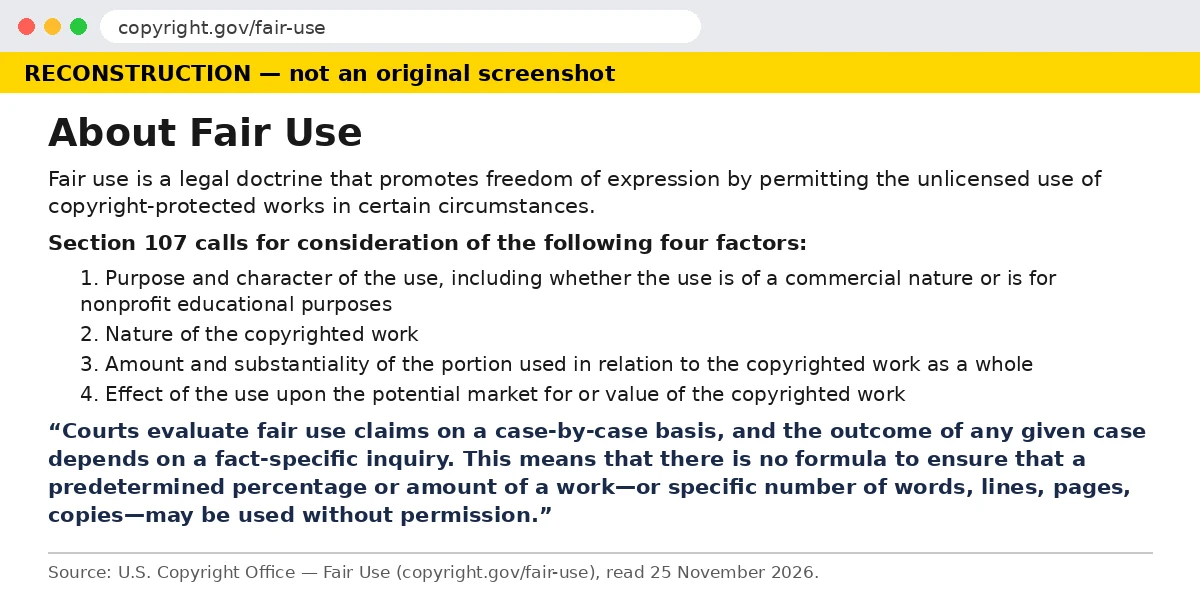
Four factors decide fair use, and no formula sets a safe amount. Below the factors, the page states the rule in its own words.
The public domain exception
Old songs can be free, but age alone does not prove it.
In the United States, works published before 1930 sit in the public domain.
Works first published in 1930 joined them on January 1, 2026.
Each New Year adds another year’s works to the public domain.
Check the composition and the recording separately.
Some 1929 songs are public domain while their 1960 recordings stay protected.
Publication year is the test, not popularity.
Forgotten 1928 ballads are free, while famous 1931 songs are not.
Public domain recordings sit beside CC tracks in the Free Music Archive, and its guide explains the license line on every track page.
Three legal ways to display lyrics
Three routes keep lyrics on your site without a takedown.
All three trade effort for safety in a different way.
| Route | What you do | What it costs |
|---|---|---|
| License them | Display full lyrics through LyricFind or Musixmatch | A paid license |
| Link to them | Send readers to a licensed lyrics page | Nothing |
| Quote briefly | Use a short excerpt inside your own commentary | Careful drafting |
Licensing is the only route that shows full lyrics.
LyricFind and Musixmatch supply licensed lyrics to Spotify, Apple Music, and YouTube Music.
Those licenses require the title, songwriters, and identifying information to stay visible.
Stripping that information breaks the license and the law.
Linking is the cheapest safe route.
Links reproduce nothing, so no permission is needed, and the reader still reaches the words.
Brief quotes work inside genuine commentary.
Discuss a line’s meaning, compare two versions, or review the songwriting, and keep the quote to what the discussion needs.
Annotation pages live in this third route.
They quote fragments to explain them, and the explanation carries the fair use argument.
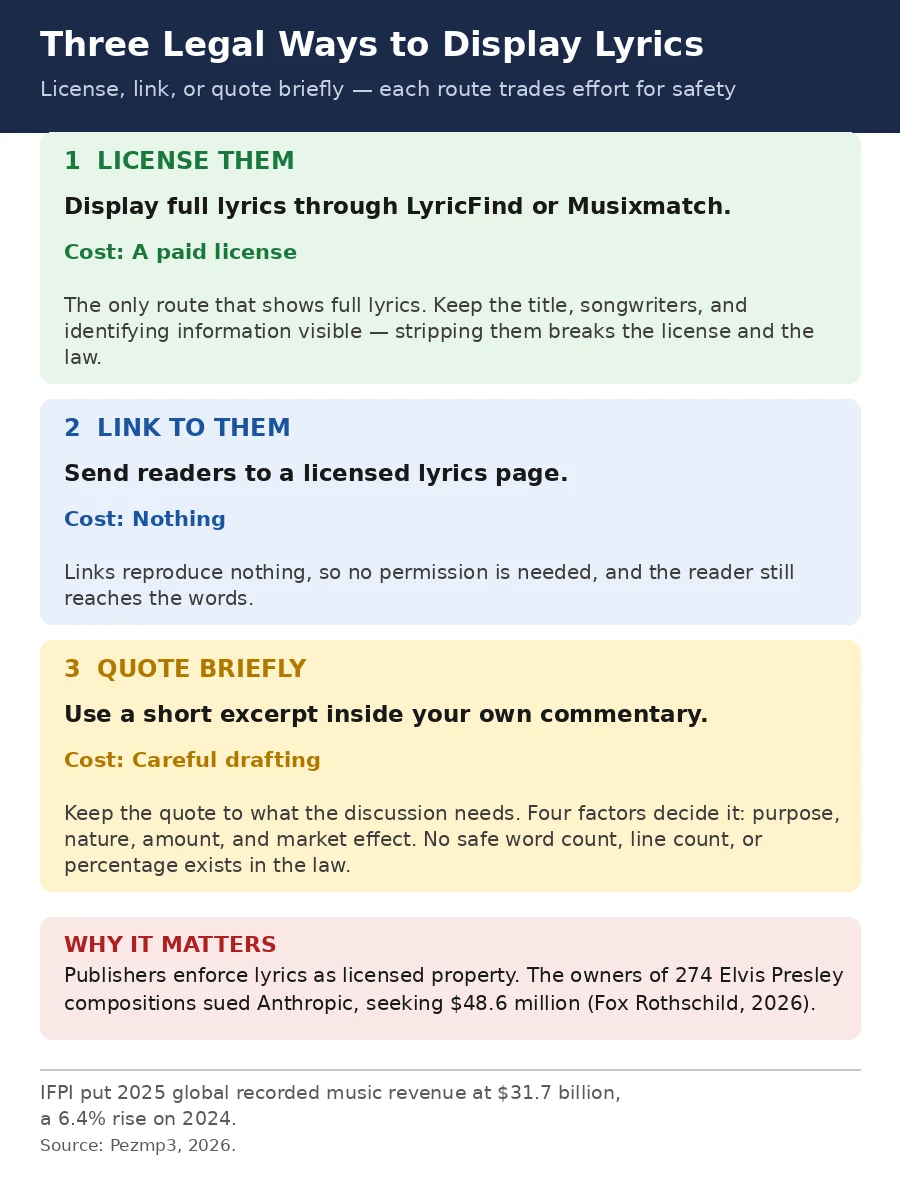
Full lyrics need a license, a short quote needs care, and a link needs nothing. Safety grows with the effort each route asks for.
What to do if you already posted lyrics
Audit the page before a takedown arrives.
Search your site for full lyrics, then license, link, or cut each one.
Treat a takedown notice as a deadline, not a negotiation.
Remove the lyrics at once, and keep a record of the removal.
Reposting the same lyrics under a new slug changes nothing.
Infringement travels with the text, not the address.
Keep the license paperwork for every lyric you display.
Saved license pages settle a claim faster than any argument.
Rebuild the page around a licensed track instead.
Royalty-Free Music for YouTube lists seven libraries whose tracks need no lyrics at all.
Methodology
Sources for the law were the U.S. Copyright Office fair use page and the LyricFind v. Musixmatch court order.
Elvis Presley suit reporting was also read in November 2026.
This article reproduces no lyric, and no publisher was contacted.
Revisit the licensor’s page before you publish; terms can shift without notice.
Frequently Asked Questions (FAQ)
Can I post lyrics if I credit the songwriter?
Credit is not permission, and a credit line does not turn an unlicensed copy into a licensed one.
Can I post just one verse?
Even one verse is still a large share of a short song.
The amount factor weighs the share taken, not the number of lines.
Are old songs safe to post?
Only when the composition itself is public domain.
Check the publication year, and check the recording separately.
Does translating lyrics need permission?
Translations are derivative works, and only the rights holder may authorize one.
Do licensed lyrics sites pay the publishers?
Licensed sites pay for display rights, which is why they run ads or subscriptions.
References
- U.S. Copyright Office Fair Use Index
- All Shook Up — Elvis Presley’s Rights Holders Sue Anthropic Over Lyrics Used to Train Claude — Fox Rothschild
- LyricFind, Inc. v. Musixmatch, S.p.A. — Order re Motions to Dismiss — Justia
- Music Streaming Statistics 2026: Revenue, Subscribers, Streams, and What Artists Actually Earn — Pezmp3
- Royalty-Free Music for YouTube: 7 Legal and Free Sources — Pezmp3
- Free Music Archive: How to Download CC0 and CC-BY Music the Right Way — Pezmp3
- Global Music Report 2026: Global Recorded Music Revenues Grow 6.4% as Record Companies Drive Innovation — IFPI