Main image: AI illustration.
More than $11 billion flowed from Spotify to the music industry in 2025, its largest annual payout ever (Spotify, 2026).
That money flows to rights holders, not to the creator who needs a soundtrack this week.
Free legal music fills that gap, and this guide shows where it lives. Every source here costs nothing up front and carries a written license.
A free download is not the same as a free use, and confusing the two is how creators lose revenue.
Seven free sources cover the whole job, from a no-credit download to a track that survives a Content ID claim.
Read it once before your next upload. Keep it open while you pick tracks.
Free Legal Music in Short
- Pick the YouTube Audio Library or Mixkit first when you want no credit line and no cost.
- Give the artist a credit on CC BY tracks, and count each Bensound or Uppbeat credit as good for one video only.
- Hold on to every license proof: a Content ID claim can land months after you upload.
- Walk away from any site that will not show its license terms in writing.
What does "free legal music" actually cover?
Free legal music means music you may use without paying per play, under a license you can read.
Royalty-free is the common name for that deal, and it says nothing about the price.
Some royalty-free tracks cost money. Others cost nothing at all.
Both kinds carry conditions, and the license page states them in writing. Read that page before you download anything.
Public domain music sits in a different group, because nobody owns its rights any more.
A recording can be free while its composition stays protected, so check both layers before you use it.
Famous songs are almost never free. Their rights holders still earn from every play.
Recorded revenue hit $31.7 billion in 2025, a 6.4% rise on 2024, and streaming supplied most of it (IFPI, 2026).
That total explains why famous songs stay locked behind licenses that cost real money. These libraries serve a different need.
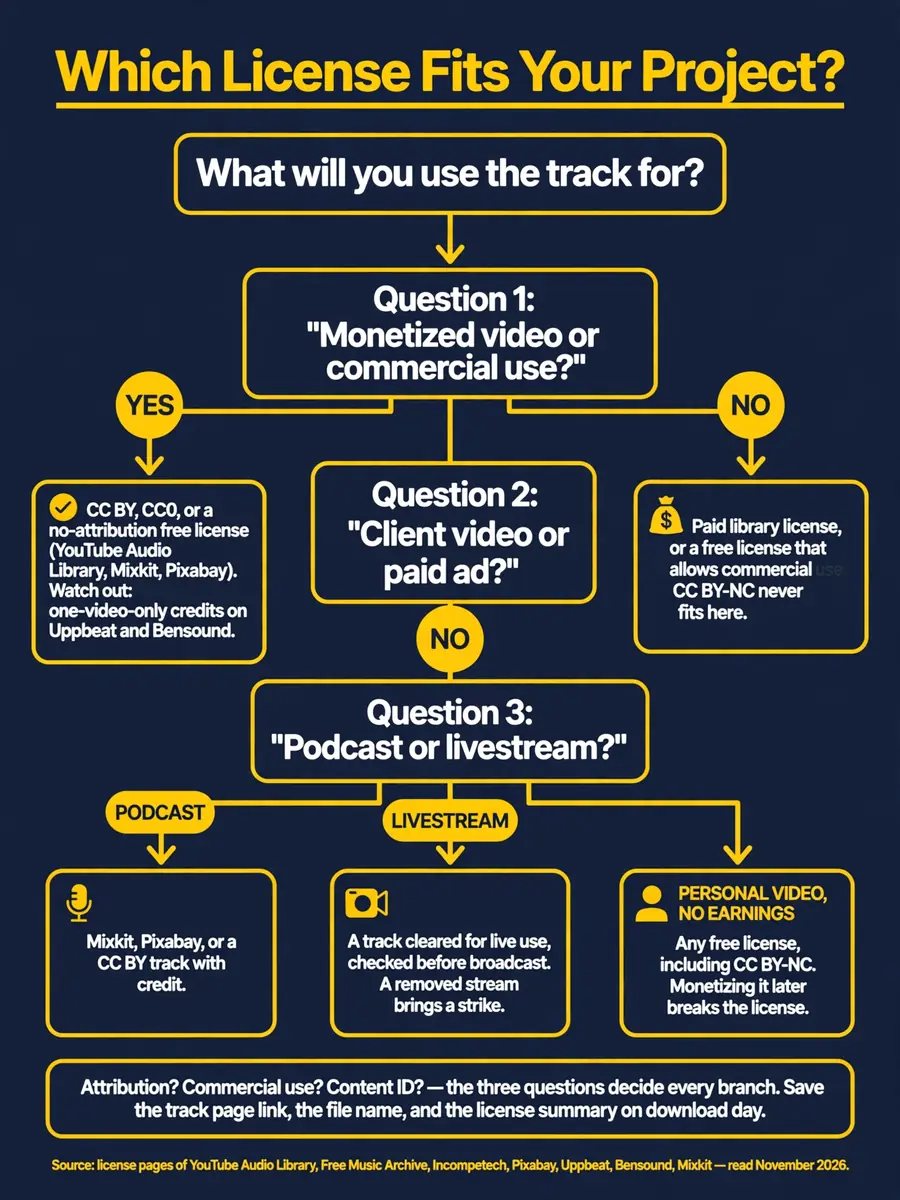
Three questions before you download anything
Three questions sort every free source into the right pile before you fall for a track.
Ask them in order, and let the answers pick the source for you. The wrong license wastes hours later.
Loving the wrong-licensed track wastes more time than picking a good track with the right one.
Does the license demand attribution?
Some licenses demand a credit line in every video description, and some demand nothing at all.
Daily publishers hate description chores. Weekly publishers can live with one credit line.
Does it cover monetized videos?
Personal-use licenses bar monetized videos, because earning money counts as commercial use. Filter for commercial use before you shortlist anything.
Can Content ID still flag it?
Yes, and that surprise catches careful creators too, because Content ID matches audio, not licenses.
Proof beats the claim, so save the track page link, the file name, and the license summary on download day.
The 7 free sources
Seven sources passed the same check, and each one states its license in writing on its own site.
Terms below come from license pages read in November 2026. Terms can change, so re-check the page before you publish.
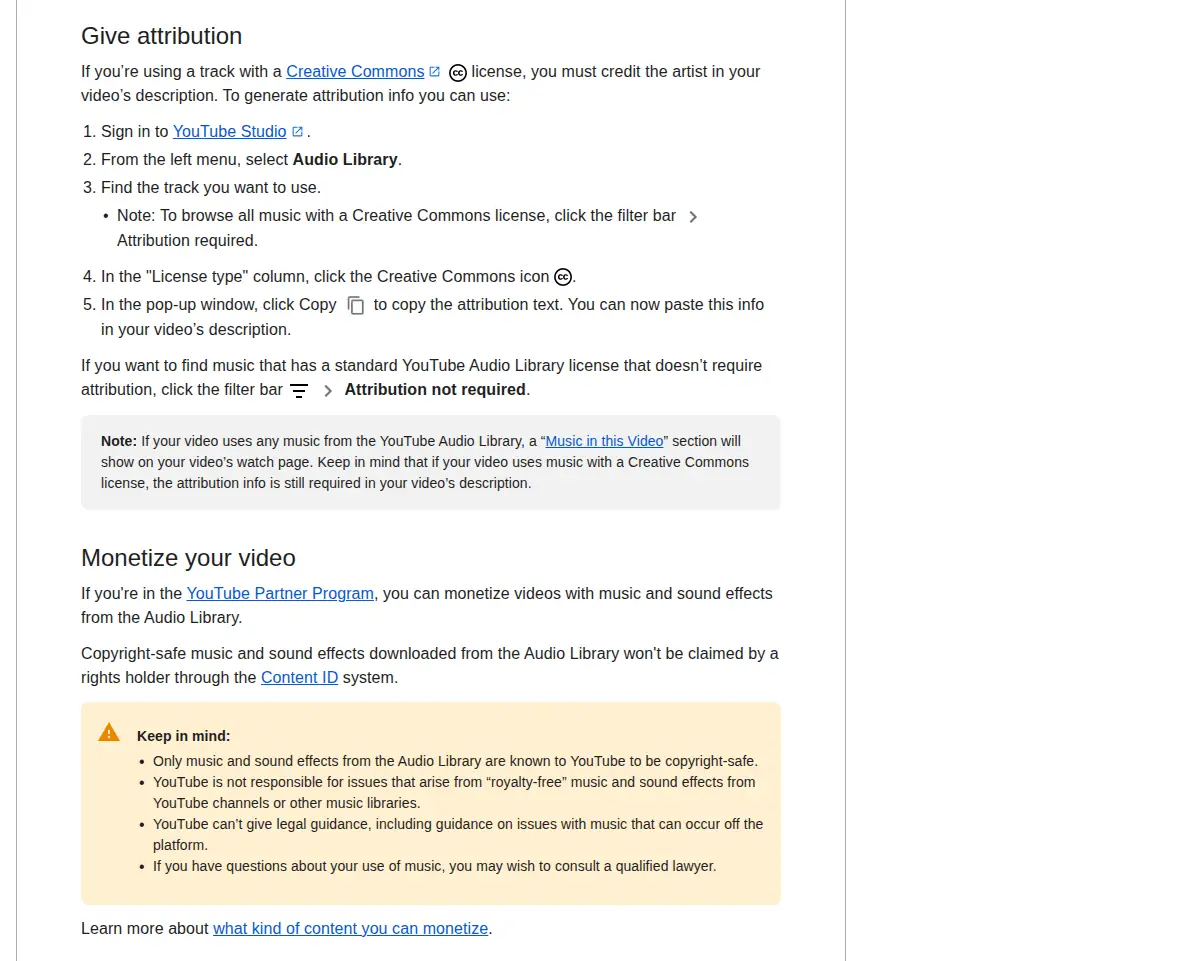
1. YouTube Audio Library
Start inside YouTube Studio: it holds the safest first step on this list. YouTube built the library for its own creators.
Most tracks here fall under the standard license of the YouTube Audio Library, which asks for no credit at all.
Smaller groups ask for a credit in your description, because they use a Creative Commons Attribution license.
Partner Program members may monetize videos using these tracks, and YouTube says Content ID will not claim them.
2. Free Music Archive
Known as FMA, the Free Music Archive holds independent music under Creative Commons licenses. Artists upload their own tracks and pick the license themselves.
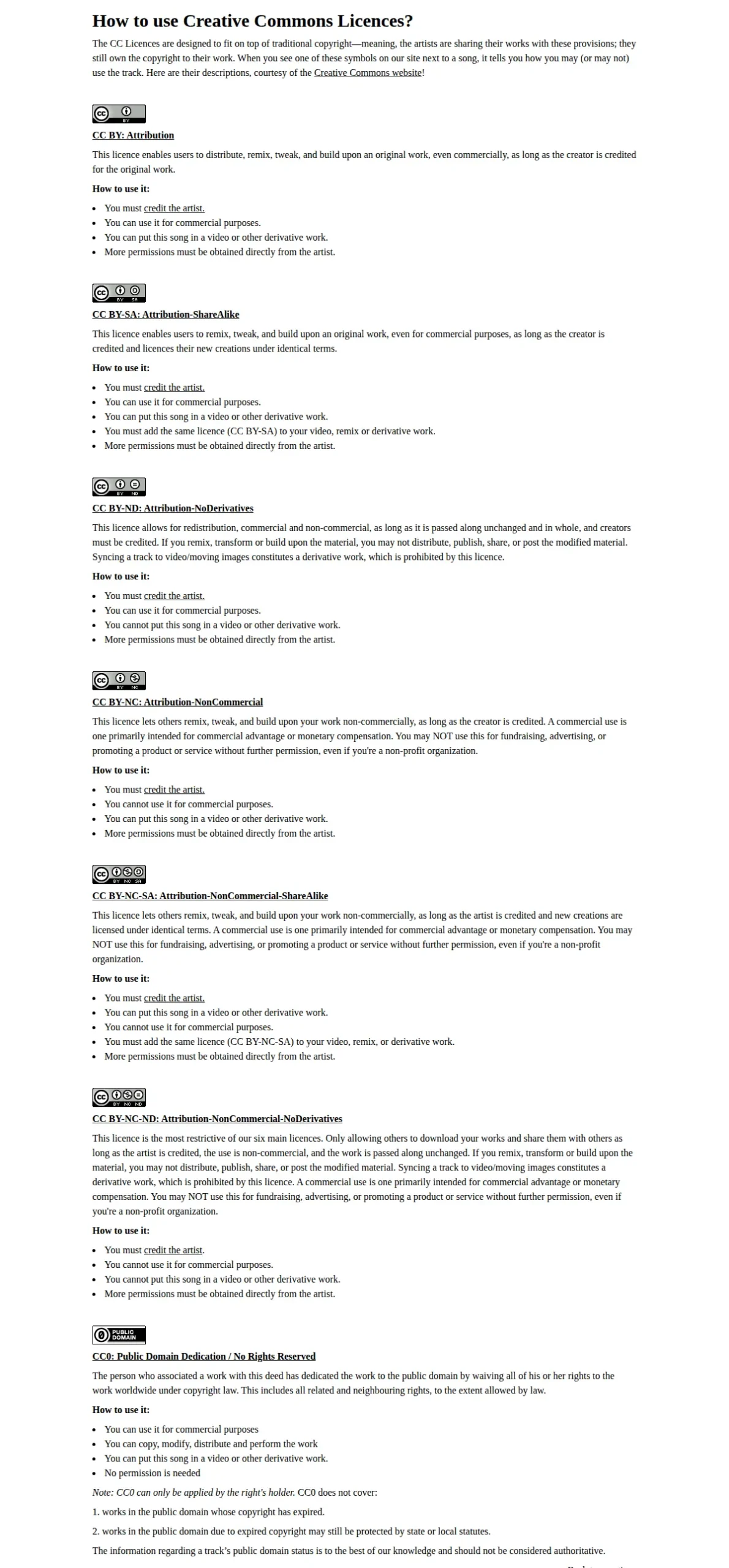
Our Free Music Archive guide walks through every license letter and the credit pattern that satisfies it.
CC BY tracks allow commercial use once you credit the artist, while CC0 tracks ask nothing at all.
Non-commercial use is barred under CC BY-NC, while CC BY-ND bars adaptations, so a video soundtrack breaks it (Free Music Archive, 2026).
3. Incompetech
Since 1997, composer Kevin MacLeod has run Incompetech, with about 1,400 original tracks in its catalog (Incompetech, 2026).
Genre, mood, tempo, and length filters make scoring a scene unusually precise.
Almost every track is free under Creative Commons Attribution 4.0, a license that allows commercial use with a credit to the composer.
You download without creating an account. Files come as MP3.
4. Pixabay Music
Pixabay Music uses the Pixabay Content License, which allows commercial use for free and asks for no credit.
Downloading needs no account, and thousands of community-uploaded tracks fill the catalog. Vlogs, lifestyle videos, and podcasts get the most from it.
Uploads stay open here, which is also the weak point, so treat it as an honest warning. Occasionally, composers register their tracks with Content ID after the fact.
Tracks registered that way carry a shield icon, so check for it before you download.
5. Uppbeat
Human-made tracks on Uppbeat come with a free plan of 3 downloads, plus 1 restored each month (Soundstripe, 2026).
Each download produces a unique credit code that belongs in one specific video description.
For a second video with the same track, download it again to get a fresh code.
Under the free tier, monetized videos are cleared, and the credit code settles Content ID claims with the site’s own release tool.
Solo creators stay covered on their own channels, but client work and paid ads need a paid plan.
6. Bensound
Behind Bensound stands one musician and a catalog of background instrumentals, with a free license that applies to tracks in the Free Music section.
Downloading creates an attribution text carrying its own license code, good for one video only.
Copy it exactly as provided, since a missing or mistyped credit can draw a claim.
Monetized YouTube videos stay under the free license; paid plans lift the credit requirement.
Every new video needs its own attribution text, even if you reuse the same song (Bensound, 2026).
7. Mixkit
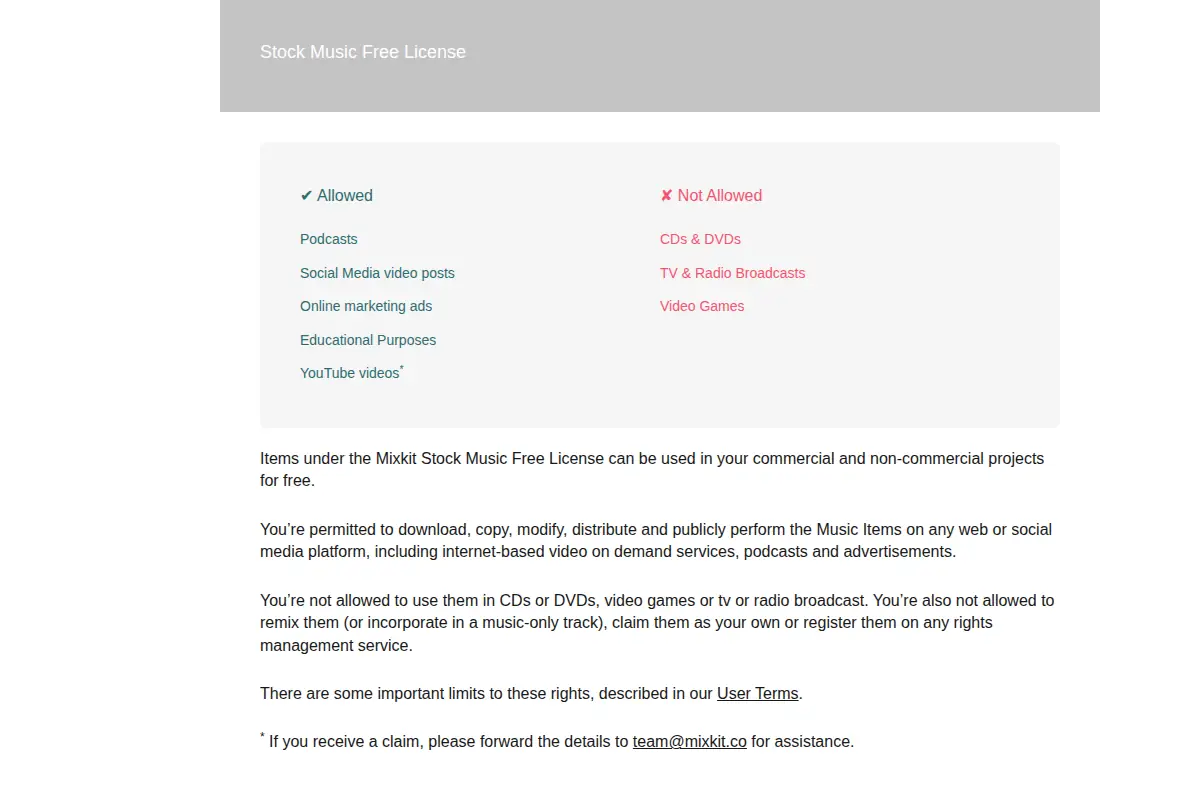
Mixkit, from Envato, offers free stock video, music, sound effects, and templates. Its music tracks carry the Mixkit Free License.
Its license covers commercial use, asks for no attribution, and needs no sign-up. Curation is the draw here: Envato’s team picks every track.
Look at each track page’s license before you use it.
Under the Free License sits almost all Mixkit music, while a few video clips elsewhere need the Restricted License, which covers personal use only.
Leave the track page open until the video goes live, so the license on record stays provable (Mixkit, 2026).
The 7 sources at a glance
| Source | License | Attribution | Monetized videos |
|---|---|---|---|
| YouTube Audio Library | YouTube license or CC BY | None, except CC BY tracks | Yes |
| Free Music Archive | Varies by track, mostly CC | Depends on the track | Only with a commercial license |
| Incompetech | CC BY 4.0 | Credit required | Yes, with credit |
| Pixabay Music | Pixabay Content License | Not required | Allowed |
| Uppbeat | Free tier license | Specific credit phrase | With the credit phrase |
| Bensound | Free License with Attribution | One credit per video | With a fresh credit |
| Mixkit | Mixkit Free License | Not required | Allowed |
Begin with the YouTube Audio Library and Mixkit, then bring in Free Music Archive for character.
Together, the trio handles daily publishing without attribution chores, and adds a deep bench of independent music for stranger videos.
Bring in Incompetech for scenes that need a score, not a song.
Uppbeat and Bensound suit weekly publishers who can manage one credit per video.
Creators who want famous songs for free find no source here, since no legal library can give a creator that.
Full seven-source detail sits in our Royalty-Free Music for YouTube guide.
Creative Commons licenses, letter by letter
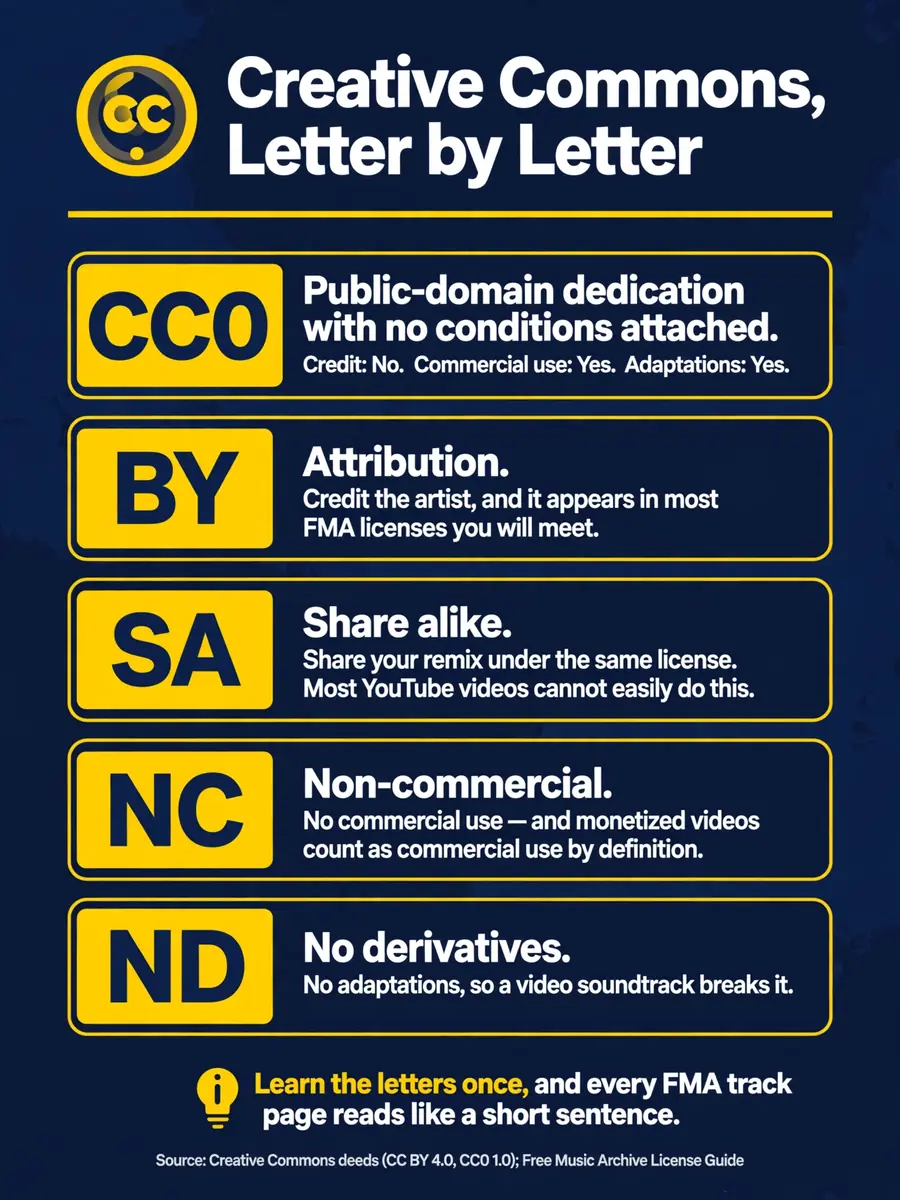
Creative Commons licenses are built from four letters, and each letter switches one permission on or off.
Learn the letters once, and every FMA track page reads like a short sentence. Guessing the letters is how a free track becomes a claim.
| Letters | What it means | Credit | Commercial use | Adaptations |
|---|---|---|---|---|
| CC0 | Public-domain dedication | No | Yes | Yes |
| CC BY | Attribution only | Yes | Yes | Yes |
| CC BY-SA | Attribution, share alike | Yes | Yes | Yes, under the same license |
| CC BY-NC | Attribution, non-commercial | Yes | No | Yes |
| CC BY-ND | Attribution, no derivatives | Yes | Yes | No |
| CC BY-NC-SA | Attribution, non-commercial, share alike | Yes | No | Yes, under the same license |
Commercial use means any use that earns money, directly or indirectly, including ads, sponsorships, and client videos.
Monetized videos count, and so does an unlisted video made for a paying client. Personal-use licenses never cover either case.
BY means credit the artist, and it appears in most FMA licenses you will meet.
SA means share your remix under the same license, which most YouTube videos cannot easily do.
NC means no commercial use, and monetized videos count as commercial use by definition. ND means no adaptations, so a video soundtrack breaks it.
CC0 is not a license at all, but a public-domain dedication with no conditions attached.
Inside the Free Music Archive guide, the TASL credit pattern runs Title, Author, Source, License.
Those four pieces, in that order, satisfy what nearly every CC BY track asks for in attribution.
Public domain: two layers, not one
Each song carries two separate copyrights, and that split surprises most creators. One covers the composition, and one covers the recording.
Composition means the melody and the words, while the recording is one performance of them.
Beethoven’s symphonies are public domain as compositions, because the composer died centuries ago. Yet a 2020 orchestra recording of one still needs its own license.
Musopen collects free recordings, sheet music, and textbooks without copyright restrictions, and it runs as a nonprofit founded in 2012 (Musopen, 2026).
Check both layers on every old track, because one free layer never frees the other.
What happens when you use music without permission?
Three outcomes follow an unlicensed track, and each one costs something different. Claims take revenue, strikes take the video, and lawsuits take far more.
Content ID claim vs copyright strike
Content ID claims are not strikes, and confusing them leads creators to panic over the wrong thing.
Claims arrive when Content ID matches your audio to a rights holder’s catalog, and the revenue then flows to that holder.
Your video stays up, and disputing a claim with proof usually clears it.
Disputing without a valid reason can escalate the claim into a removal request, which brings a strike.
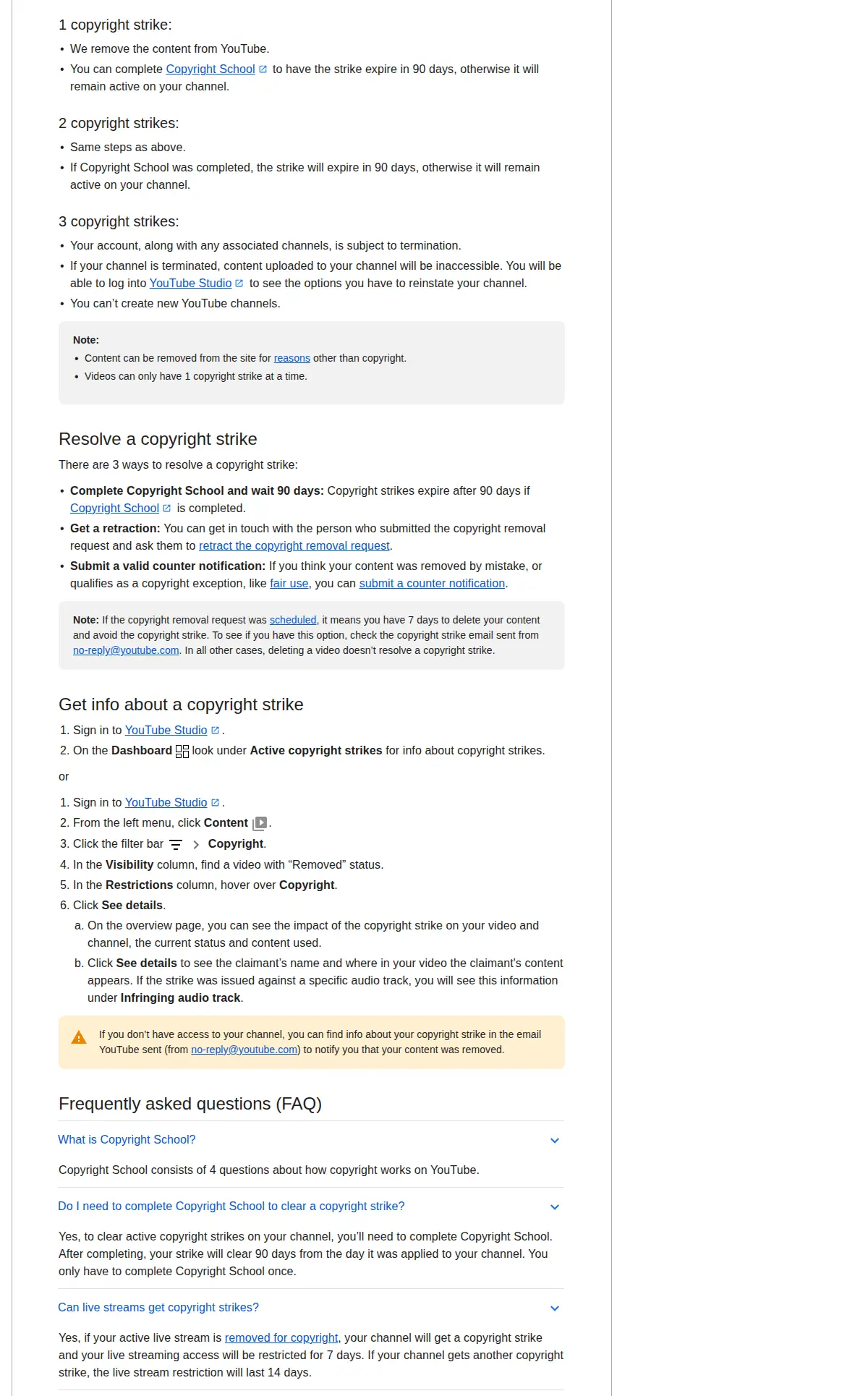
Strikes mean YouTube removed your content after a legal removal request from the rights holder (YouTube, 2026).
Strikes expire 90 days after you complete Copyright School, as long as you collect no more than two (YouTube, 2026).
Collecting three strikes within 90 days ends the channel, and a removed live stream brings a strike plus a 7-day live restriction (YouTube, 2026).
Dispute the claim, or replace the track?
Legal tracks deserve a dispute when a claim lands, and your saved proof makes each dispute short.
Wrong-license tracks deserve replacement, because no dispute can fix a license you never had. Swap the audio, re-upload, and move on.
Is it fair use?
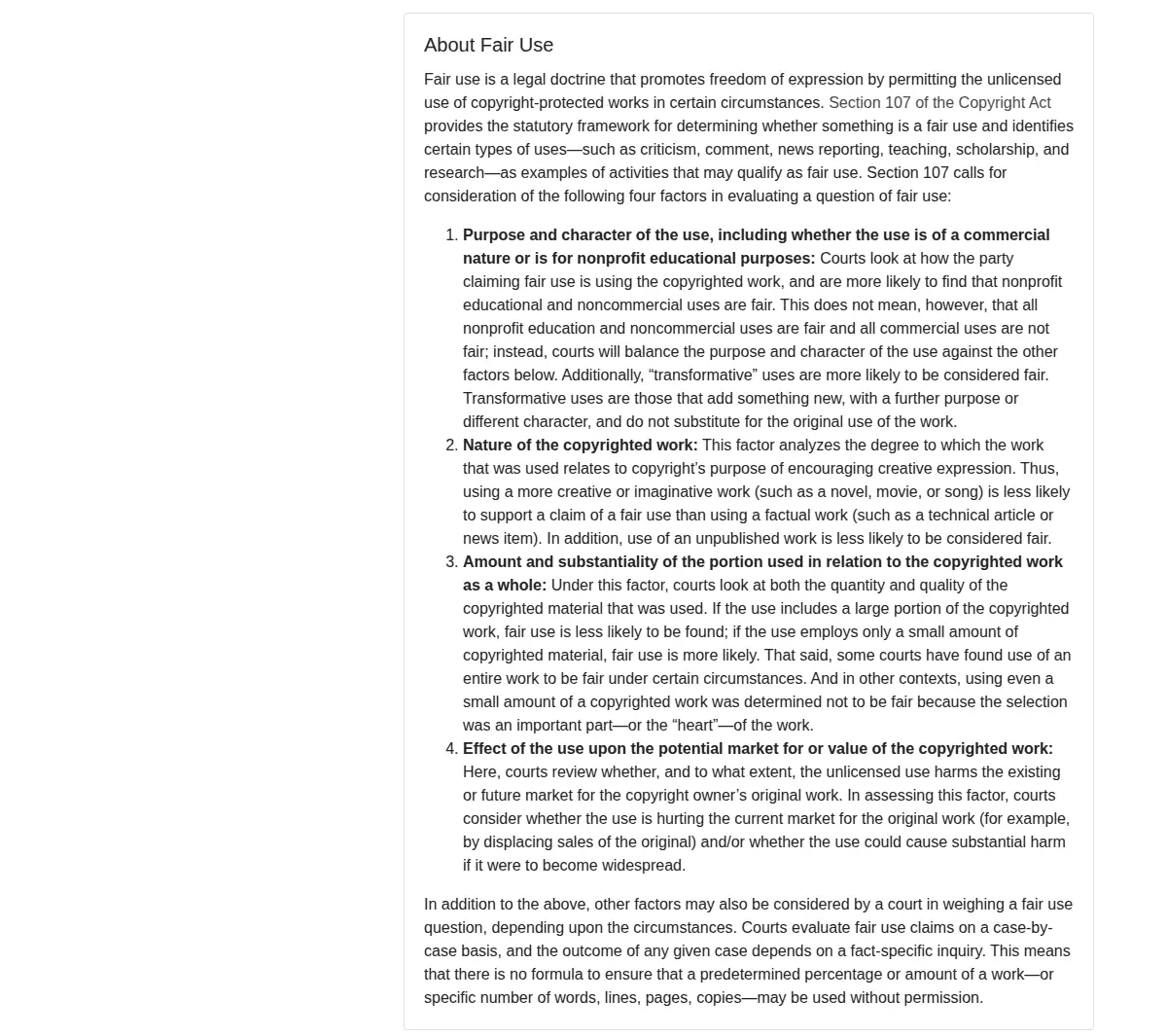
Fair use is a legal defense, not a permission slip, and it is decided case by case in court.
Copyright law weighs four factors, and no single factor decides the outcome (Copyright Office, 2026).
Purpose and character come first, including whether your use transforms the original into something new.
Songs are creative works, so that factor usually weighs against a creator who reuses one.
Amount matters too, and using the heart of a song hurts more than using a short edge.
Market effect closes the list, because a use that replaces the original rarely survives the test.
Short clips, credit lines, and good intentions do not make a use fair on their own.
Percentages promise nothing, so nobody can say that 30 seconds is safe. Assume the strictest reading until a lawyer says otherwise.
When free stops being enough
Most creator needs fit free libraries, and paid libraries exist for the rest. Client work, paid ads, and broadcast sit outside most free licenses.
Artlist runs a royalty-free catalog of more than 900,000 digital assets, and a free account only offers watermarked songs (Artlist, 2026).
Paid subscriptions unlock unlimited unwatermarked downloads, so check current pricing on the site before you commit.
Epidemic Sound licenses its catalog directly, and content published during an active subscription stays cleared forever (Epidemic Sound, 2026).
After you cancel, new content is no longer cleared, so finish the series before the subscription ends.
Soundstripe sells pre-cleared royalty-free music by subscription or by single-song license, and free social-platform libraries usually grant no commercial use (Soundstripe, 2026).
Paid libraries fit creators who publish for clients, run ads, or need a track cleared in writing within the hour.
Own-channel creators who can live with attribution chores fit free libraries best. Pick the paid route the day a client pays for the video.
Which video types need which license?
Match the license to the video type, because one license never fits every upload. Five common cases cover most creators.
| Video type | License that fits | Watch out for |
|---|---|---|
| YouTube video, monetized | CC BY, CC0, or a no-attribution free license | One-video-only credits on Uppbeat and Bensound |
| Client video or paid ad | Paid library license, or a free license that allows commercial use | CC BY-NC never fits here |
| Podcast episode | Mixkit, Pixabay, or a CC BY track with credit | Some free tiers cover only solo creators |
| Livestream | A track cleared for live use, checked before broadcast | A removed stream brings a strike |
| Personal video, no earnings | Any free license, including CC BY-NC | Monetizing it later breaks the license |
When the video type changes, the license must change with it, so re-check before you reuse a track.
Podcasts and livestreams
Podcasts and livestreams follow the same licenses, and the platform changes which risks matter.
Episodes live forever, while a live stream can be muted mid-broadcast.
Many free licenses in this guide allow podcasts, including Mixkit and Pixabay, but read each track page first.
Solo creators on social platforms fall under Uppbeat’s free tier, while Bensound’s free license covers online videos viewers can watch without paying.
Live streams carry a sharper risk, because a removed stream brings a strike and a 7-day live restriction on the first offence (YouTube, 2026).
Second removals extend that restriction to 14 days, so keep the music licensed before you go live (YouTube, 2026).
Twitch rules were not verified for this guide, so check the platform’s own music rules before you stream there.
File formats and the conversion workflow
MP3 handles delivery, WAV handles recording and editing, and FLAC handles archiving.
Match the format to the job, not to habit, and sizes stop being a fight.
| Format | 3-minute song | 1 hour | Quality |
|---|---|---|---|
| 128 kbps MP3 | About 3 MB | About 58 MB | Lossy |
| 192 kbps MP3 | About 4 MB | About 86 MB | Lossy |
| 320 kbps MP3 | About 7 MB | About 145 MB | Lossy |
| FLAC | 15–21 MB | 300–420 MB | Lossless |
| WAV 16-bit/44.1 kHz | About 30 MB | About 605 MB | Uncompressed |
As 320 kbps MP3, three minutes of music weigh about 7 MB; as FLAC, 15–21 MB; as WAV, 30 MB (Wikipedia, 2026; Xiph.org, 2026).
An hour of WAV fills about 605 MB, while 100 hours take about 60 GB in WAV and 15 GB as 320 kbps MP3.
Streaming brings a different kind of size: a song streams at the bitrate it was encoded at.
One 320 kbps stream eats about 7 MB per song, so most platforms pick 128 or 192 kbps instead.
Converting an MP3 to WAV never improves the sound, because the data MP3 removed is gone for good.
Our MP3 vs FLAC vs WAV guide shows the full size table and the record-edit-archive-deliver workflow.
Convert your own files, the legal way
Convert only files you own or files under a license that allows conversion.
Never rip audio from YouTube or Spotify, because their terms forbid it and no converter makes it legal.
Audacity converts WAV to MP3, FLAC, and Ogg, and it is free and open source (Audacity, 2026).
FFmpeg converts and streams audio and video across platforms, and it is also free and open source (FFmpeg, 2026).
- Do your recording and editing in WAV, so every cut keeps its quality.
- Keep a WAV master with the project files after you export it.
- Put finished work in FLAC to archive it, saving half the space.
- For video, podcasts, and streaming, deliver MP3 at 320 kbps.
Why artists still get paid, and why so little per stream
Streaming fills the industry’s coffers while most individual tracks earn almost nothing, and that gap shapes the practical choice.
Worldwide, recorded revenue reached $31.7 billion in 2025, a 6.4% rise on 2024 (IFPI, 2026), with streaming crossing $22 billion for the first time.
By the end of 2025, paid accounts hit 837 million worldwide, up from 764 million after IFPI restated 2024 (IFPI, 2026).
On-demand plays hit 5.1 trillion in 2025, a record, with 3.7 trillion of them outside the United States (Luminate, 2026).
Spotify’s 2025 payout topped $11 billion, and its lifetime total now nears $70 billion (Spotify, 2026).
| Service | Average per stream | Per 1 million streams |
|---|---|---|
| Qobuz | About $0.01873 | About $18,730 |
| Tidal | $0.012–$0.015 | $12,000–$15,000 |
| Apple Music | $0.007–$0.010 | $7,000–$10,000 |
| Deezer | $0.005–$0.007 | $5,000–$7,000 |
| Amazon Music | $0.004–$0.008 | $4,000–$8,000 |
| Spotify | $0.003–$0.005 | $3,000–$5,000 |
Rates shift with each service’s pool of subscription and advertising money.
All the subscription and advertising money lands in one pool per service, then divides by stream share.
Spotify pays about $0.003 to $0.005 per stream on average (Ditto Music, 2026), or $3.00 to $5.00 for every 1,000 streams.
Independent master owners averaged $3.00 per 1,000 streams in Duetti’s 2024 data (Duetti, 2025).
About two-thirds of the money Spotify’s music generates (Spotify, 2026) goes to rights holders. Labels, distributors, publishers, and artists divide that share under their contracts.
Recording royalties from Spotify go only to tracks that passed 1,000 streams over the prior 12 months (Spotify, 2026).
Below that line, tracks earn nothing in Spotify recording royalties, and most tracks sit there.
In 2025, about 88% of tracks stayed at or below 1,000 streams, so artist income rides on volume, not the rate (Luminate, 2026).
Full numbers sit in our Music Streaming Statistics 2026, and the per-stream breakdown sits in What One Stream Pays in 2026.
AI-generated music: a new corner with old rules
AI tools now generate full songs in seconds, and creators ask whether those songs are free to use.
Answers depend on the tool’s terms, because the tool, not the creator, often holds the rights.
Certain tools grant commercial use of their output, while others keep the rights or demand a paid plan.
None of the tools here had its output license tested, so read the terms of the tool you use before you publish.
An AI song can also echo a real song too closely, and that risk belongs to the creator who publishes it.
Treat AI music like any other source: read the license, save the proof, and keep the file.
Build your music system once, reuse it forever
Systems beat searches, because hunting one track per video eats the evening. Build the system once, then reuse it for every upload.
Store each track with its license summary and its credit text in one folder per license type.
Name files so the format shows: track-master.wav, track-archive.flac, track-final.mp3. Clear names keep the master out of the upload slot when you meant the delivery file.
Shared spreadsheets of approved tracks save the next creator on your team the same search.
Review the folder every six months, because licenses change and artists re-upload tracks with new terms.
What getting it wrong really costs
Losing one video’s revenue stings, and most creators survive that lesson.
Channel loss ends the audience you built, and rebuilding takes far longer than 90 days.
Lawsuits cost money, time, and sleep, and one can follow a video that earned almost nothing.
Spend five minutes on the license line and you gain a soundtrack no claim can reach.
Minutes buy the cheapest fix, and a lost channel is the most expensive one. Spend the minutes first.
Pre-publish checklist
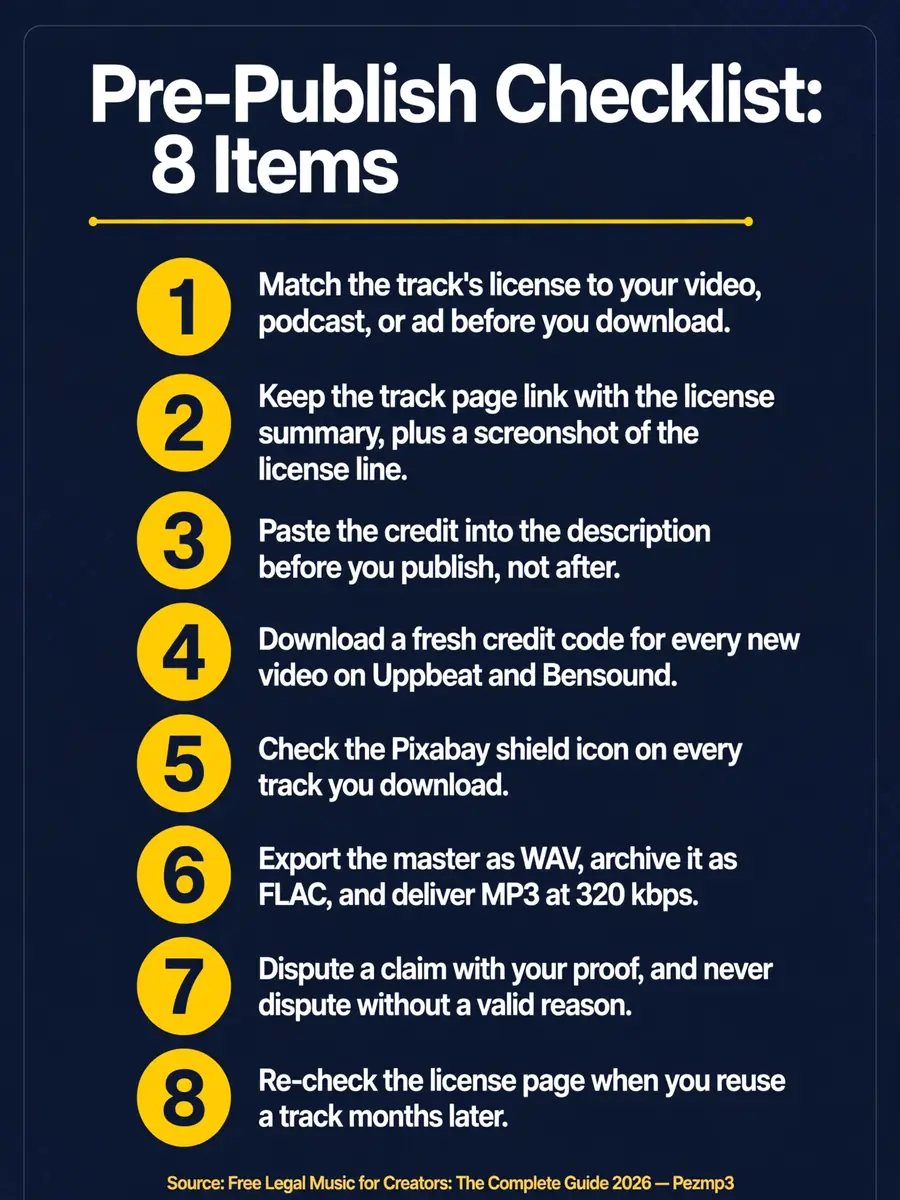
Run this list before every publish, and keep it beside your upload screen.
- Match the track’s license to your video, podcast, or ad before you download.
- Keep the track page link with the license summary, plus a screenshot of the license line.
- Paste the credit into the description before you publish, not after.
- Download a fresh credit code for every new video on Uppbeat and Bensound.
- Check the Pixabay shield icon on every track you download.
- Export the master as WAV, archive it as FLAC, and deliver MP3 at 320 kbps.
- Dispute a claim with your proof, and never dispute without a valid reason.
- Re-check the license page when you reuse a track months later.
Legal free music is not a shortcut, and the creators who treat it as a system publish faster, argue less, and keep every video earning.
Start with one track, one license, and one saved proof, and the rest of the system builds itself.
Methodology
License claims below trace to the source’s own license or FAQ page, read in November 2026, or to a roundup that quotes that page.
Nothing here is legal advice for your situation; when a license page and this guide disagree, the license page wins.
IFPI, Luminate, RIAA, Spotify, and Ditto Music supplied the industry figures, from reports for 2025 and 2026 read in full or through official summaries.
Fair use and strike rules were checked against the United States Copyright Office and YouTube Help pages in November 2026.
Paid-library prices were not listed, because they change often and only the sites themselves carry current figures.
Where a license page itself could not be reached, the claim traces to a roundup that quotes that page.
Figures that could not be verified were left out rather than estimated.
Frequently Asked Questions (FAQ)
Does royalty-free mean the music costs nothing?
Royalty-free means you pay nothing per play, while free means you pay nothing at all.
Does free music block monetization?
Monetization stays open whenever the license covers commercial use.
No credit is needed for the YouTube Audio Library, Mixkit, or Pixabay; Incompetech, Bensound, and Uppbeat ask for one.
How do I answer a Content ID claim on a track I licensed legally?
Raise a dispute in YouTube Studio and attach your proof: track page link, license summary, attribution text.
Audio Library tracks should draw no claims at all, and showing the license usually clears Pixabay and Bensound claims.
Must every track carry a credit to its artist?
Not every track needs one. Audio Library tracks on the standard license, Mixkit, and Pixabay ask for no credit.
CC BY tracks from FMA and Incompetech always need one, while Bensound and Uppbeat ask for a specific credit per video.
Can free music score a podcast or a TikTok?
Mostly yes, if the conditions fit.
Podcasts are allowed under the Mixkit and Pixabay licenses, and solo creators on social platforms fall under Uppbeat’s free tier.
Online videos viewers can watch at no cost fall under Bensound’s free license.
References
- Use music and sound effects from the Audio Library — YouTube Help
- License Guide — Free Music Archive
- FAQ For Videos and Films — Free Music Archive
- Incompetech
- Pixabay Music and Sound Effects Alternatives in 2026 — Sonilo
- Free Background Music for YouTube (2026) — Soundstripe
- Frequently Asked Questions — Bensound
- Mixkit License
- Deed — CC BY 4.0 — Creative Commons
- Deed — CC0 1.0 Universal — Creative Commons
- Fair use — United States Copyright Office
- Copyright strikes — YouTube Help
- Circular 56A: Copyright Registration of Musical Compositions and Sound Recordings — United States Copyright Office
- Musopen
- Artlist
- Epidemic Sound
- Audacity
- FFmpeg
- Xiph.org — FLAC format
- Wikipedia — MP3
- Wikipedia — WAV
- Wikipedia — FLAC
- Music Streaming Statistics 2026: Revenue, Subscribers, Streams, and What Artists Actually Earn — Pezmp3
- Spotify Paid the Music Industry More Than $11 Billion in 2025 — Pezmp3
- What One Stream Pays in 2026: Fractions of a Cent on Every Major Service — Pezmp3
- Global Recorded Music Revenue Hits $31.7 Billion in 2025 as Streaming Passes $22 Billion — Pezmp3
- Music Streams Hit a Record 5.1 Trillion in 2025, Luminate Reports — Pezmp3