

A candy dispenser that played music sounded like a joke in 2005. Then a stay-at-home dad from Springfield, Missouri, turned the joke into a licensed product.
The PEZ MP3 player held 512 MB of songs inside a plastic dispenser with a swappable character head (CNET, 2005). Lincoln West Studio sold it for $99, and the first production run sold out (StreetDirectory, 2026).
This article traces the player from a basement idea to a collector item. Every number below carries its source and year, because two early reports disagree on the price.
Summary
- A licensed PEZ dispenser with 512 MB of storage, an LCD screen, and six buttons (CNET, 2005).
- The first production run sold out at $99, after CNET had reported a planned $129 price (StreetDirectory, 2026; CNET, 2005).
- Any standard PEZ head fits the player, so owners could swap a Star Wars head onto the body (CNET, 2005).
- Press coverage ran from CNET in March 2005 to Make the same month, with Fortune following in May (Make, 2005; Fortune, 2005).
- Safety certification stalled the second production run, and the player faded from sale by 2007 (StreetDirectory, 2026).
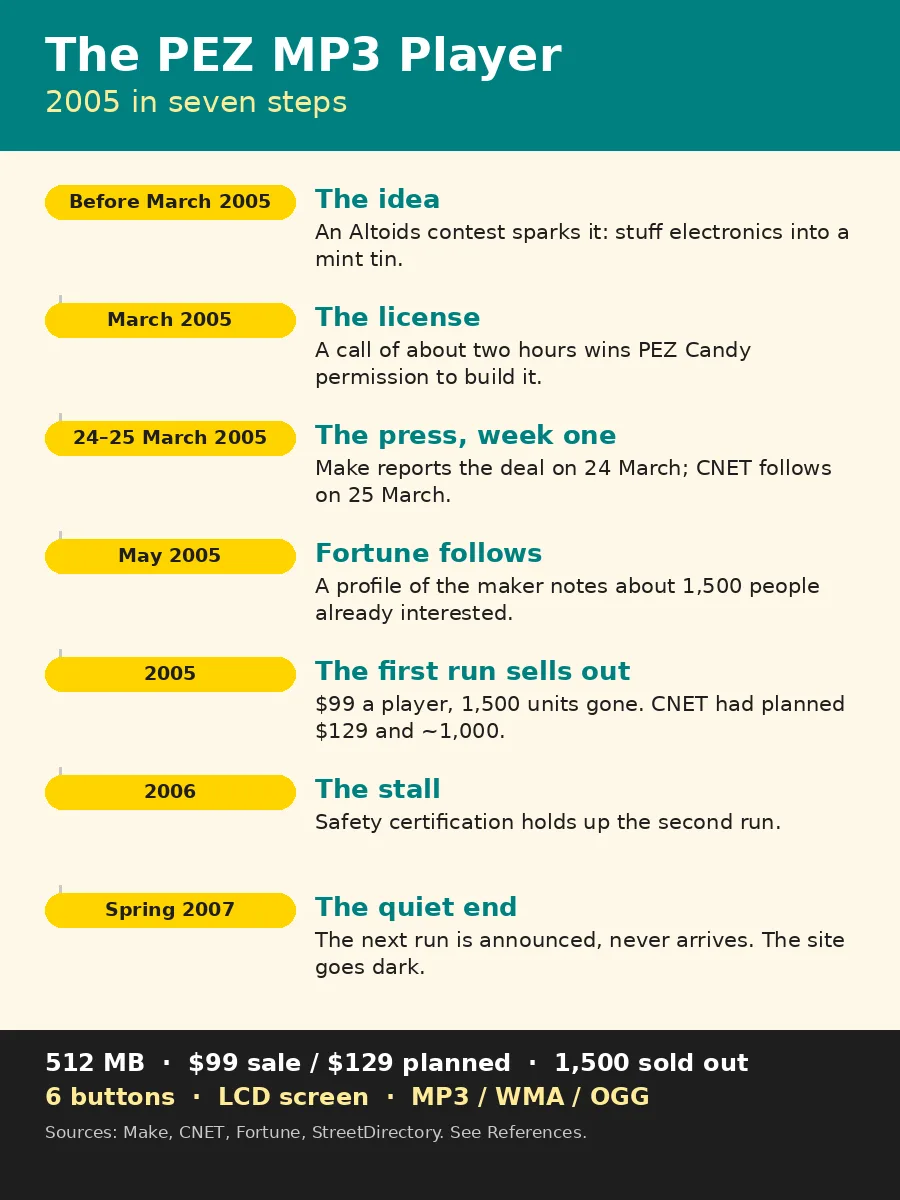
Seven steps from a basement idea to a sold-out first run, a stalled second run, and a dark website.
What was the PEZ MP3 player?
It was a flash-memory music player shaped like a PEZ dispenser, complete with a flip-back character head. Inside the plastic shell sat a Samsung chip, 512 MB of storage, and a small LCD screen (CNET, 2005).
Six buttons controlled playback, and the screen mimicked the readouts on other small players of the time (CNET, 2005). Owners loaded songs over USB, since the player mounted as a flash drive on a computer (Make, 2005).
Formats covered MP3, WMA, and OGG, which was generous for a novelty player in 2005 (Make, 2005). Earbud headphones came in the box, along with the USB cable (CNET, 2005).
Who built it, and how did the idea start?
Patrick Misterovich, a stay-at-home dad in Springfield, Missouri, built the player through his one-person company, Lincoln West Studio (CNET, 2005). He had worked in information technology at the University of Detroit Mercy before turning to gadget design (Fortune, 2005).
An Altoids contest sparked the idea, after a winner stuffed an iPod speaker into a mint tin (CNET, 2005). Misterovich asked himself what else could become electronics, then paired candy with music players on a list (StreetDirectory, 2026).
Within about two hours of calling PEZ Candy, he had licensing permission to build the player (StreetDirectory, 2026). That speed still surprises people who have ever negotiated a brand license.
Before the PEZ player, Misterovich had sold MP3 players for children under the Secondhand Monkeys name (CNET, 2005). Sales were modest, so the PEZ license looked like a stronger bet on a brand people already loved (CNET, 2005).
What did it cost, and how many were made?
Two early reports disagree, so this section keeps them apart instead of blending them. CNET reported in March 2005 that the first run would hold about 1,000 units at $129 each (CNET, 2005).
Later accounts give different numbers: $99 per player, with a first production of 1,500 units that sold out quickly (StreetDirectory, 2026).
One likely explanation is a plan versus a sale price, since CNET wrote before launch and the later account describes the sale itself.
Buyers ordered directly from Lincoln West Studio, not from shops, which kept the first run small and direct (CNET, 2005). By one later account, PEZ approved a second production run once the first sold through (StreetDirectory, 2026).
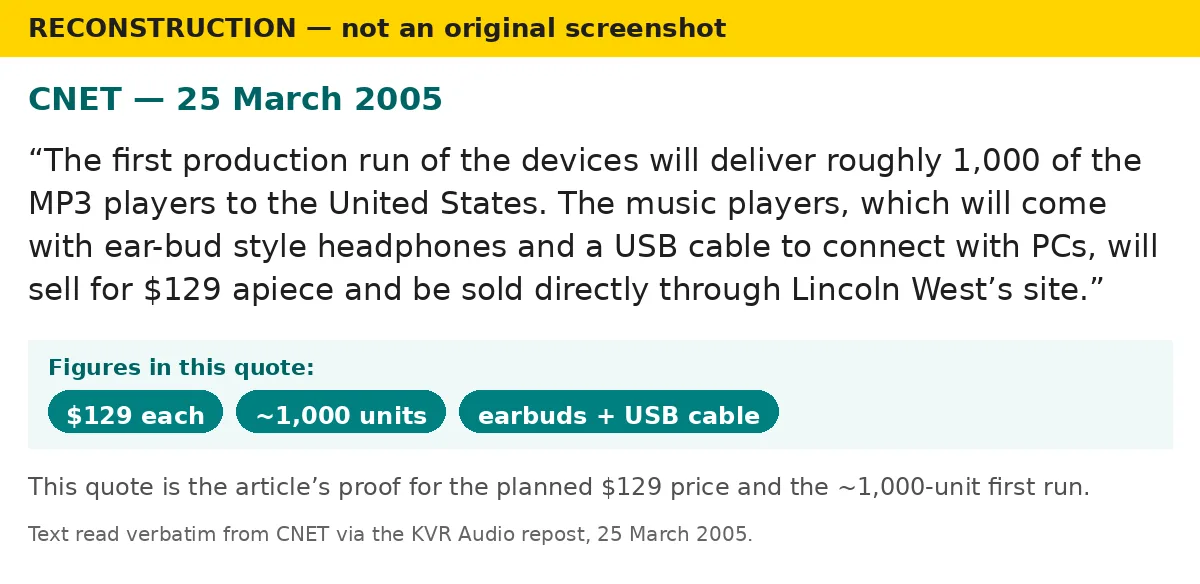
Roughly 1,000 players at $129 each: that was the CNET plan, with earbuds and a USB cable in the box.
Why did the press love it?
Novelty carried the story, since a candy dispenser with a screen was easy to photograph and hard to forget. Make covered the licensing deal on 24 March 2005, the same week CNET ran its story (Make, 2005).
Fortune profiled Misterovich in May 2005 as part of a story on do-it-yourself makers, noting about 1,500 people had already shown interest (Fortune, 2005). That interest came with no advertising, only a blog and a few dollars of search ads (StreetDirectory, 2026).
Each outlet framed the same facts differently: CNET stressed the license, Make stressed the maker, and Fortune stressed the amateur economy. Together they turned a basement project into a national curiosity within weeks.

Make reported the licensing deal on 24 March 2005, listing 512 MB, six buttons, and MP3, WMA, and OGG support.
Why did the second run stall?
Electronics need safety certification, and the player had to pass Underwriters Laboratories testing before a second run could ship (StreetDirectory, 2026). Misterovich secured the certification, then announced the next run for spring 2007 (StreetDirectory, 2026).
No second run ever reached buyers in any number the record shows, and the story goes quiet after that announcement. His site later went dark, and the domain went up for sale (StreetDirectory, 2026).
Short supply did what marketing could not: it turned a $99 gadget into a scarce object collectors chase. Scarcity alone never guarantees value, though, and the next section weighs what the player is actually worth.
Is the PEZ MP3 player a collectible now?
Surviving players change hands among PEZ collectors and retro-tech buyers, though no public price guide tracks them. Listings are rare, so any price you see reflects one seller and one buyer, not a market.
Condition decides most of the value, as with every vintage player in our guide to old MP3 players worth money. Working players with their box and cable beat bare players every time.
Streaming now carries the music instead, passing $22 billion in 2025 (IFPI, 2026). At 69.6% of recorded music revenue, that sum makes a 512 MB player feel like a museum piece today.
What can you play on it today?
Any legal MP3 download still loads straight onto the player, since it takes MP3 files (Make, 2005). Lower bitrates fit more songs, though 128 kbps sounds audibly worse on good headphones.
For tracks, start with the PEZ MP3 player that gave this site its name: our pillar guide lists seven sources that cost nothing up front. Pick tracks with a written license, then copy the MP3 files over USB.
File size still matters at 512 MB, and our format guide shows a 3-minute song taking about 7 MB as 320 kbps MP3. About 70 songs fit by that math, so pick the tracks you actually play.
Conclusion
$99 bought a candy dispenser that played music, and the first run sold out before most people heard of it. Its story still teaches the same lesson: a strong idea plus a real license beats a big budget.
If you own one, keep the box and cable with it, since completeness is what collectors pay for. If you only want the music, our free legal music guide shows where to find tracks that cost nothing.
Frequently asked questions
Can the PEZ MP3 player hold candy?
No. Candy never fit inside, since the head only swaps for looks (CNET, 2005).
How many songs fit on 512 MB?
About 70 songs at 320 kbps, since a 3-minute song takes about 7 MB. Shorter songs and lower bitrates fit more, while longer albums fit fewer.
Why do two sources disagree on the price?
CNET wrote before launch about a planned $129 price, while the later account describes the $99 sale itself (CNET, 2005; StreetDirectory, 2026). Neither number is invented, and the article keeps both visible instead of picking one.
Where can I buy a PEZ MP3 player today?
Only from collectors and secondhand listings, since no shop has stocked the player for years. Check that the player powers on and the head swaps cleanly before you pay.
What music can I load onto it?
Load any MP3 you own or may legally use, including tracks from the free sources in our pillar guide. Free libraries that offer MP3 downloads suit a 512 MB player well.
Methodology
Facts come from the 2005 press coverage and a later retelling, all opened and read on 26 November 2026. Undated pages are cited by access year, and the price disagreement is shown rather than smoothed over.
One item named in the planning notes, an Engadget story from October 2005, could not be opened here, so it is not cited below. File sizes are arithmetic from the verified bitrates, not copied from a chart.
References
- PEZMP3 player is a go!
- Pez to dispense MP3s instead of candy
- Sweet About Me Music
- The Amazing Rise of the Do-It-Yourself Economy
- Music Streaming Statistics 2026: Revenue, Subscribers, Streams, and What Artists Actually Earn — Pezmp3
- Free Legal Music for Creators: The Complete Guide 2026 — Pezmp3
- MP3 vs FLAC vs WAV: Which Audio Format Is Right for Creators? — Pezmp3