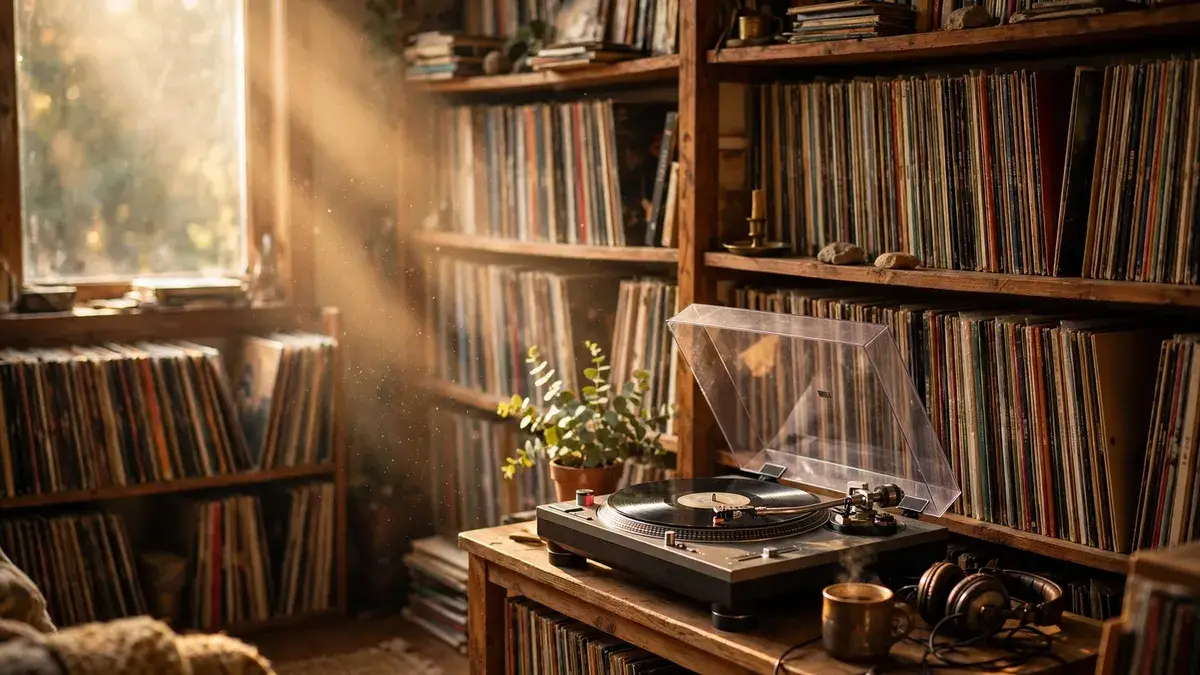
Main image: AI illustration.
One track sounded perfect for the closing scene, and the download button sat right there, free. Weeks later, the video carried a copyright claim anyway.
Free Music Archive is a library of Creative Commons music where every track carries its own license. Downloading costs nothing, but using a track legally means matching its license to your video, podcast, or ad.
Summary
- Every track on FMA carries its own Creative Commons license.
- CC0 tracks need no attribution; CC BY tracks need credit.
- CC BY-NC bars commercial use, and CC BY-ND bars use as a video soundtrack.
- Check the license on the track page before you download, and save the page as proof.
What is the Free Music Archive?
WFMU, a radio station in East Orange, New Jersey, founded the archive in 2009 with KBOO and KEXP. It grew into a library of over 100,000 recordings from independent artists around the world (FMA, 2016).
The archive nearly shut down in November 2018, when WFMU announced it could no longer run the site. KitSplit acquired it that December, and Tribe of Noise took it over in September 2019.
Today the site still runs, still free to browse, and still built on Creative Commons licenses. Its survival matters because few free libraries survived the 2010s with their licenses intact.
Its catalog spans folk, electronic, hip hop, classical, and dozens of smaller genres. Independent artists upload most of it, which is why the licenses vary track by track.
Is everything on the Free Music Archive free?
Downloading is free, but using is not always free. Each track carries the license its artist chose, and that license decides what you may do with it.
Some tracks allow commercial use with credit, while others allow only personal listening. A few carry no conditions at all, because the artist dedicated them to the public domain.
That word free on the download button describes the price, not the permission. Permission lives on the track page, in the license line beside the player.
What is the difference between CC0 and CC BY?
CC0 is a public-domain dedication, the closest thing to no license at all. You may copy, remix, and use a CC0 track commercially without asking anyone or crediting anyone.
CC BY is a common license on FMA, and it allows commercial use with one condition. That condition is attribution: credit the artist, link the source, and name the license.
Attribution is not a favour to the artist; it is the price of the license. Skip it, and your use stops being legal, even though the download was free.
Two other letters change everything: NC bars commercial use, and ND bars adaptations. A video soundtrack counts as an adaptation, so a CC BY-ND track cannot score your video.
SA, or ShareAlike, lets you remix only if you share your version under the same license. Most YouTube creators avoid SA tracks, because a video cannot easily carry the same license.
Can I edit, remix, or loop a track?
Editing depends on the ND and SA letters, not on the download button. Trimming a CC BY-ND track for your intro counts as an adaptation, so it breaks the license.
Looping a CC BY track is fine, because looping does not change the work itself. Remixing a CC BY-SA track is fine too, as long as you share your remix under the same license.
Which license fits my project?
Match the license to the project before you fall in love with the track. Falling for a track with the wrong license costs more time than choosing a good track with the right one.
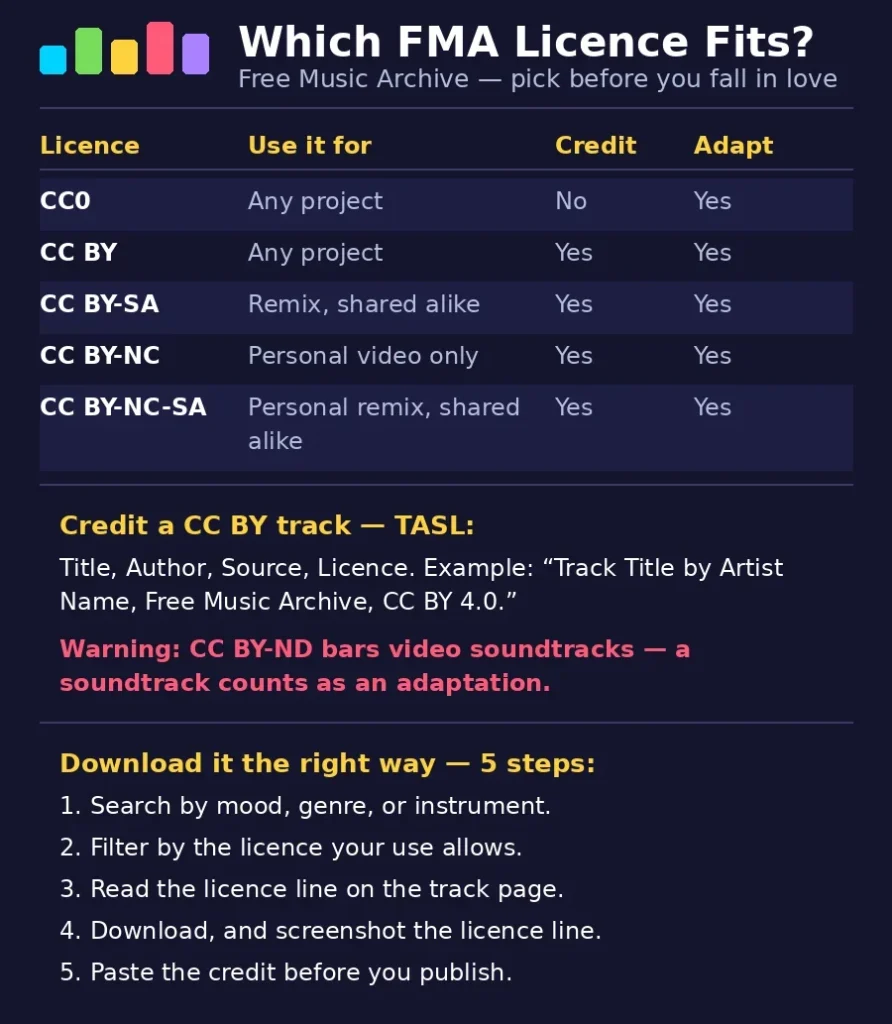
| Project | License to pick | Credit | Adaptations |
|---|---|---|---|
| Any project, no credit wanted | CC0 | No | Yes |
| Any project, credit is fine | CC BY | Yes | Yes |
| Remix shared under the same terms | CC BY-SA | Yes | Yes |
| Personal video only | CC BY-NC | Yes | Yes |
| Personal remix shared alike | CC BY-NC-SA | Yes | Yes |
How do I download music from the Free Music Archive the right way?
Five minutes of checking saves hours of dispute later. Follow the steps in order, and keep a record of each one.
Start with the archive’s charts and curated playlists, not with a blank search box. Curators group tracks by mood and genre, which beats guessing keywords for an hour.
- Search by mood, genre, or instrument, then open the track page.
- Use the license filters to show only tracks your use allows.
- Read the license line on the track page before you download.
- Download the track and save a screenshot of the license line.
- Paste the credit into your video description before you publish.
Filters matter more than search terms, because a perfect track with the wrong license is useless. FMA lets you filter by Public Domain, Commercial Use, and Use in a Remix or Video, so start there.
How do I credit a CC BY track correctly?
Credit follows the TASL pattern: Title, Author, Source, License. Four pieces, in that order, cover the attribution condition for nearly every CC BY track.
Here is a working credit: “Track Title by Artist Name, Free Music Archive, CC BY 4.0.” Link the track page and the license deed from the credit, so a viewer can check both.
Place the credit where viewers can find it: the video description, the show notes, or the credits roll. Burying the credit in a pinned comment counts poorly, because comments can vanish.
What can go wrong with a free track?
Reading “free” as “free for anything” is the most common mistake. With perfect credit, a CC BY-NC track in a monetized video still breaks the license.
Licenses can also change when an artist re-uploads a track or edits its terms. Your screenshot of the license line at download time is the record that protects you.
Re-uploads cause a third problem: a track you found elsewhere may carry a stricter license than the original. Download from the track page itself, not from a mirror, a compilation, or a re-upload.
Content ID adds a final risk, though FMA tracks themselves are rarely registered. Someone else may have registered a re-uploaded copy, which is another reason to use the original page.
How does the Free Music Archive compare with other free libraries?
FMA wins on license clarity, because every track shows its license beside the player. YouTube Audio Library wins on safety, because its tracks carry no Content ID risk at all.
Incompetech wins on consistency, because one artist wrote nearly every track under the same CC BY license. Pixabay and Mixkit win on simplicity, because their tracks need no credit at all.
Use FMA when the license matters more than the download speed, and use the others when it does not. Our guide to seven free sources for YouTube compares all of them side by side.
Patient creators get the reward here. Five minutes with the license line buys a soundtrack no claim can touch.
Methodology
This guide was written from the Free Music Archive license guide and FAQ, the Creative Commons license deeds, and the archive’s history pages.
All of them were read in November 2026. Every license claim was checked against the official text, not against a summary on another site.
No track was downloaded or used for this article, and no artist was contacted. License terms can change, so check the track page again before you publish.
This article was written by a human author with AI assistance for drafting and checking; every fact was verified against the sources listed below.
Frequently asked questions
Is the Free Music Archive still active?
Yes.
The archive runs today under Tribe of Noise, after WFMU, KitSplit, and Tribe of Noise each kept it alive since 2009. New tracks still appear, and the license filters still work.
Can I use FMA music in a monetized YouTube video?
Yes, when the track’s license allows commercial use. CC0 and CC BY tracks allow it; CC BY-NC tracks do not.
Do I need an account to download from FMA?
No.
Downloads work without an account, and no sign-up is needed to browse the license filters. Keep your own record of the license, because the site keeps none for you.
What happens if I use a CC BY track without credit?
Your use stops being legal, even if the download was free. Artists can ask for the video to be taken down, and a platform can remove it.
Can I use FMA music in a paid ad?
Only with a license that allows commercial use, and never with a CC BY-NC track. Check the track page first, because an ad is commercial use by definition.